



Traktory i sel hozmashiny
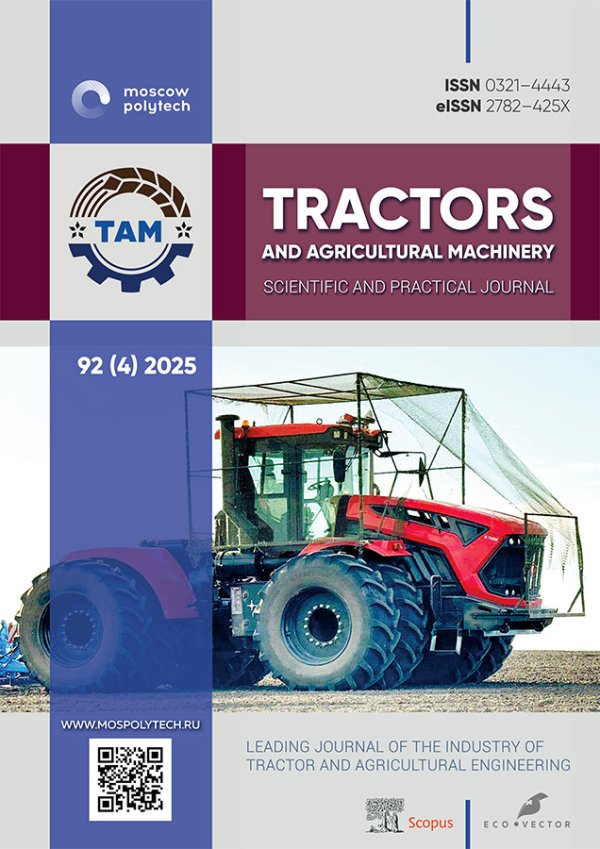
The peer-reviewed journal "Tractors and Agricultural Machinery" publish six times a year (bimonthly).
About
Leading journal of tractor and agricultural machinery industry, which acquired a reputation of impartial, reliable and informative edition.
Mission of the journal is to keep experts informed of the latest achievements of scientific and engineering thought, to familiarize them with the results of tests of new tractors and agricultural machines, as well as with new trends of development of the agroindustrial complex.
Main themes:
- agricultural machinery market;
- environmentally friendly technologies and equipment;
- new machines and equipment;
- theory, designing, testing;
- quality, reliability;
- agricultural service;
- foreign agricultural technologies and equipment;
- economics, organization and technology of production;
- exhibitions, fairs, conferences.
Publisher
- Eco-Vector
Editor-in-Chief
Valery Kaminsky, Ph.D., Professor
ORCID iD: https://orcid.org/0000-0002-1449-6479
Indexation
- Russian Science Citation Index
- Google Scholar
- WorldCat
- Ulrich's Periodicals Directory
Distribution
- Open Access
- No APC
- СС BY-NC-ND 4.0 International
最新一期
卷 92, 编号 4 (2025)
- 年: 2025
- 文章: 14
- URL: https://medbiosci.ru/0321-4443/issue/view/24798
- DOI: https://doi.org/10.17816/0321-4443-2025.92.4
完整期次
Environmentally friendly technologies and equipment
Increasing the efficiency of yield of combustible fraction of pyrolysis liquid from plant raw materials
摘要
BACKGROUND: Today, the use of technologies related to the production and use of renewable energy (bioenergy) is gaining popularity in the energy industry. The use of bioenergy is due to the gradual depletion of fossil resources on which the fuel and energy industry relies. Bioenergy is based on the production of energy from biofuels. At the moment, there is an active development of technologies for the production and expansion of the range of application of various types of biofuels in bioenergy.
AIM: Consideration of the possibility of increasing the efficiency of the yield of the combustible fraction from liquid products of slow pyrolysis of plant materials used in the production of biofuels.
METHODS: The study was conducted experimentally in two stages on the experimental installations for the pyrolysis of plant materials and the separation of pyrolysis liquid shown in the diagrams. The first stage consisted of the process of obtaining liquid products of slow pyrolysis of plant materials. The essence of the second stage consisted of separating the liquid products obtained at the first stage into individual fractions or components in order to identify areas of their application. After each stage, the chemical composition of the obtained products was analyzed with a liquid chromatograph.
RESULTS: The results of studies on obtaining pyrolysis liquid and separating liquid pyrolysis products into separate distillate fractions are described. As a result of the studies, liquid pyrolysis products were obtained from: pine chips, spruce chips, corn cobs and plum pits, which were separated into a liquid and resinous fraction. Both fractions were analyzed for combustion and it was found that the liquid fraction has flammable properties.
CONCLUSION: The use of a two-condenser system increased the efficiency of liquid slow pyrolysis products by 19% due to the additional recovery of combustible components. This additional recovery increased the proportion of furans, ketones, and esters in the combustible fraction. The combustible fraction, consisting of furans, ketones, esters, aldehydes, alcohols, and anhydrous sugars, exhibits flammable properties and can be assumed to be suitable for biofuel production.
 326-335


Problems of electric transport operation
摘要
The growth of production of electric motor-driven vehicles is due to the aim to reduce air pollution in the areas of their operation. The aim of the review is to analyze the issues of the electric vehicles distribution due to the provision of charging infrastructure and the functional characteristics of the electric vehicles themselves.
The issues of electric vehicle operation associated with the availability and design of electric charging stations and the type of traction batteries are considered. In addition, the data based on collecting and analyzing the characteristics of the stations in one of the regional centers of Russia and within a radius of 100 km from this center are given. The distribution of electric transport requires, firstly, the sufficient level of the charging infrastructure and its compliance with the design of the charging ports of electric vehicles. Secondly, reducing the charging time of traction batteries, which is still significantly longer than the time of refueling cars with traditional fuel. And thirdly, ensuring the possibility of not only urban and suburban, but also long-distance trips on one charge of traction batteries. Lithium-ion traction batteries are most commonly used in electric vehicles due to their high energy density. However, their disadvantage is that they are effective at an ambient temperature down to -7°C, which predetermines the mileage on one charge in winter by 20-30% less than in the warm season, due to both a decrease in battery capacity and the use of electricity to provide heating of the electric vehicle interior and power supply of various consumers. To analyze the spreading of stations, along with the criteria of “number of electric vehicles per stations” and “distance between neighboring stations”, the criterion of “number of charging stations per area unit of the region” is important. The value of this review lies in the assessment of the problems of operating electric vehicles, including providing specific data for one of the regions of Russia.
336-344


New machines and equipment
Development of a robotic agricultural machine for broadcast sowing of crop seeds
摘要
BACKGROUND: This paper considers the issue of designing a robotic agricultural machine for broadcast sowing seeds of agricultural crops, the scope of which includes various agricultural companies, agricultural industry, as well as small farms engaged in sowing grain crops. Existing sowing machines have a common disadvantage, which is that the moist soil adheres to the surface of the working bodies, in particular the two-disc shares of these machines, causing changing the shape of the groove and forming a pre-sowing hill, which violate the requirements for sowing. These factors worsen the quality of the work performed, an increase in traction resistance is observed, which leads to an increase in fuel costs..
AIM: Development of a robotic agricultural machine equipped with a disk spreader, which is capable of operating in automatic mode with minimal human participation..
METHODS: The design was carried out using the KOMPAS-3D V19 three–dimensional CAD software. Existing approaches in the design and engineering of industrial robots were used. An exploratory study method was used, including an analysis of known disk spreaders.
RESULTS: The paper presents the design and operating principle of a robotic agricultural machine, including a description of the frame where the control unit, a seed tank, a seed line with a flap, a belt drive, drives, a chain coverer, a disc spreader and a furrowing roller are mounted. The design of a disc spreader with concave guides, ensuring an even distribution of seeds over the surface of the field, is proposed.
CONCLUSION: The proposed design will ensure complete robotization of broadcast sowing of grain crops, so that the technological operation — sowing will be performed with minimal human participation, which in turn eliminates various human factors when performing the work. In addition, the cost of paying the staff of employees is reduced.
345-350
Application of mobile electric power storage systems for agricultural machinery with traction electric drive
摘要
The problem of reducing greenhouse gas emissions is relevant not only for manufacturing enterprises, motor transport, but also for agriculture. Decarbonization of the industry includes the conversion of tractors and agricultural machinery to traction electric drive, but creates a number of issues, including with charging infrastructure. Mobile electric charging stations with energy storage devices can be one of the ways to solve the shortage of electricity. Aim of the review is to find solutions for alternative methods of charging infrastructure development that can be applied in the agricultural sector.
During the research, the method of analyzing the existing problems of the charging station infrastructure development was used and methods for their solution were proposed. A new direction for the development of charging infrastructure and methods for solving problems of uneven loading of electric grids are proposed. Results. The analysis of designs of tractors with electric drive, mobile electric charging stations and electric charging connectors is carried out. The relevance of using energy storage devices in order to reduce dependence on electric grids to increase mobility and range of electric transport is indicated.
The application of the proposed solutions in the transport infrastructure will make it more convenient to operate both agricultural and road electric vehicles and will help accelerate the development of electric vehicles. The application of the proposed solutions in power grids will reduce peak local loads and will contribute to a more even distribution of energy and load on generating capacities.
351-362
Theory, designing, testing
Transient characteristics of a wheeled machine with a vibration-protective seat
摘要
BACKGROUND: Shock and vibration loads caused by the microrelief of the supporting surface negatively affect both the health of operators of ground transportation and technological machines and the quality of work performed due to the deterioration of reactions and attentiveness. Vibration-protective seat systems are an effective means of mitigating dynamic effects on operators. Development of vibration-protective systems of operators’ seats is a relevant task.
AIM: Development of a mathematical model of a machine with a vibration-protective seat system, taking into account a given input force data and damping coefficients, which will make it possible to study the response of the system to a typical impact when the chassis wheels ride on a step. The model should determine the transient characteristics of a wheeled vehicle with a vibration-protective seat, have a high speed of calculation of the dynamic process, which will ensure simultaneous optimization of more parameters.
METHODS: To develop the model, flat design scheme of the front axle wheels riding on a step of a given height is considered. The vehicle rides on the step with the front axle only, the step height is small relatively to the wheelbase. The vertical oscillations of the center of mass were approximated by a linearized mass oscillation model with one translational degree of freedom. The differential equation of motion of the chassis mass is used to model the vertical coordinate of motion of the seat base. The assumptions of rigid fixation of the operator’s cabin on the chassis and smallness of the mass of the seat with the operator relative to the chassis mass are adopted. The calculation scheme for modeling vertical oscillations of the mass of the seat with the operator relative to the chassis is similar to the scheme of oscillations for the chassis relative to the ground. Two schemes are used simultaneously in one simulation model. Modeling of vertical oscillations of the chassis and the seat with the operator when the chassis wheels ride on a step is carried out using a simulation mathematical model in the SimInTech Russian simulation environment.
RESULTS: As an example of the use of the developed simulation model, the results of modeling of a separate transient process of the machine front axle wheels riding on a step with a height of 0.1 m at a velocity of 1 m/s are given. he results are presented in the form of time dependencies of vertical coordinates of the support surface, base chassis, deformation of the vibration protection mechanism of the seat and corresponding time dependencies of absolute velocity and acceleration of the seat with the operator. The maximum value of the absolute acceleration of the seat with the operator was determined.
CONCLUSION: The simulation model of the riding on a step developed using the SimInTech Russian software takes into account elastic and viscous properties of tires, tire-and-step interaction geometry and nonlinearity of the force response of the vibration protection system. The model is able to simulate the transient process rapidly, which opens up the possibility of analyzing multiple variants and optimizing parameters.
363-372
Methodology of the Study of the Shock Absorption System of the Operator’s Seat of a Mobile Power Unit Based on a Simulation Model
摘要
BACKGROUND: Improving the working conditions of the operator of a mobile power unit by reducing vibration impact while improving the design and characteristics of elastic-damping properties is a relevant task that can be solved at the present stage by using automated modeling systems to develop simulation models with a sufficient level of detail.
AIM: Definition of research methodology for improving the shock absorption system of the operator’s seat of a mobile power unit based on a simulation model.
METHODS: Computer simulation modeling and experimental studies with the registration of dynamically changing signals, methods of experimental data smoothing based on optimization and evaluation of results using dispersion analysis are used in the study. The resulting system simulation model of a seat with a series-produced suspension is validated based on the manufacturer’s experimental data for subsystems. Experimental studies are conducted to debug the definition and preliminary processing of the model’s input data for conducting a model experiment, which allows creating test scenarios.
RESULTS: The developed simulation model, when conducting a numerical experiment based on experimentally obtained scenarios of operation, showed good quality of prediction of the processes under study. This made it possible to formulate a methodology for conducting research based on the methods considered.
CONCLUSION: The proposed method makes it possible to reduce the time of research and material costs for the development and evaluation of new design solutions, including in the field of active and semi-active elastic-damping elements. Using a system model allows studying the mechanism and evaluating the operation of individual elements and subsystems. In addition, the numerical and full-scale experiments showed that the series-produced suspension of the operator’s chair of a mobile power unit does not always cope with the task of smoothing out shocks in vibration, which suggests the need for further development of the design. One of the possible areas of further research is the creation of a model of a subsystem of an active or semi-active elastic damping device and comparative tests to evaluate and optimize design solutions.
373-383
Statistical model for analysis of mass, power and traction characteristics of agricultural tractors
摘要
BACKGROUND: One of the challenges of modern agricultural industry is the integration of digital and robotic technologies, pursuing the reduction of the human factor in the production chain. Transition from manned agricultural transport and technological machines to autonomous ground mobile facilities (AGMF) is of particular interest. An agricultural tractor is a universal pull-push mobile system of the agricultural industry (ACI), so it can be used as an optimal platform for the design of the AGMF chassis. At the design stage of unmanned ground mobile systems, it is necessary to develop such a technical solution that allows the AGMF to function effectively without loss of mobility. The developed drawbar load has a significant impact on the mobility of the agricultural tractor on the ground. Therefore, in order to obtain an optimal technical solution, it is necessary to define the interrelation between the key characteristics of tractors, helping to select the primary parameters of the AGMF chassis.
AIM: Definition of interrelation between technical and design parameters of wheeled and tracked agricultural tractors as mathematical dependencies in order to select primary parameters of the AGMF.
METHODS: Building of the statistical model was based on compiling a sample of the existing models of agricultural tractors and determining the type of mathematical regularities between technical parameters as regression equations.
RESULTS: Regression equations defining the interrelation between tractor engine power, gross weight, specific engine power and specific ground pressure were obtained, and primary technical parameters of AGMF were selected.
CONCLUSION: The practical value of the study lies in the possibility of using the obtained parameters in the selection of primary parameters in the design, ensuring the competitiveness of the machine in a certain traction-power segment and compliance with agro-technological requirements.
384-392
Quality, reliability
Improving the quality of piston-type hydraulic machines
摘要
BACKGROUND: The paper discusses the issues of improving the quality of piston-type hydraulic machines. The base case is the mud pump. The service purpose of the mud pump is to supply mud.
The main problem that occurs when operating hydraulic machines of this type is increased wear of the working surfaces of the cylinder sleeves. This is mainly due to the presence of fractions in the drilling mud, which have increased abrasive properties. To increase the durability of the assembly, high-chromium alloyed cast irons of the IChKh-22 type are used as a material for making the sleeve. However, these parts are expensive. It should also be noted that high-quality cast iron has worse foundry properties compared to other types of cast iron (for example, gray cast iron).
AIM: Evaluation of the possibility of improving the quality of piston-type hydraulic machines by improving the design of the cylinder assembly.
METHODS: To improve the quality of piston-type hydraulic machines, it is proposed to use gray cast iron, which is hardened by heating in contact with a mixture of oxides of alloying elements. Considering the fact that quality is a complex property, it is reasonable to evaluate it based on a comparison of both technical and economic aspects. The complex assessment was carried out using a differential method based on technical and economic indicators: tightness of the connection of the “sleeve-rod” pair, wear rate of the surface layer of the cylinder sleeve, strength, rigidity and cost. The tightness and wear were determined by calculation using experimental data on the properties of the hardened layer, and the strength and stiffness of the bushings were determined using the finite element method.
RESULTS: The results obtained show that the proposed variant is not inferior to the basic one in terms of wear resistance and tightness, and is significantly more efficient in terms of cost. Analysis of the options was carried out without taking into account technological aspects such as processing performance and the percentage of defects. As a perspective for further research, these criteria should also be looked at.
CONCLUSION: In the course of the research, it was found that the working part of the sleeve, which is made of alloy cast iron, can be replaced with modified gray cast iron. As a result of the assessment of the quality level, it was found that the resulting quality indicator for the proposed option is higher than for the basic one. Although the specific quality indicators characterizing the functional purpose for modified cast iron are somewhat lower, the economic effect of using such bushings is significantly higher than its counterpart. Thus, the resulting indicator characterizing the quality of bushings in general for modified gray cast iron significantly exceeds its analogues.
393-399
The influence of wave strain hardening on the corrosion resistance of welded joints of structural steels in agricultural machinery
摘要
BACKGROUND: Corrosion damage to structural steels, especially in welded joints of agricultural machinery, leads to significant economic losses (3-5% of GDP). In addition to the main conventional methods of corrosion protection (painting, galvanizing), the technology of manufacturing (hardening) of parts has a significant impact on corrosion resistance. The effect of surface plastic deformation (SPD) on corrosion resistance remains insufficiently studied, especially for welded joints of steels of the agricultural industry.
AIM: Definition of quantitative patterns of the influence of wave strain hardening (WSH) parameters on the corrosion resistance, microstructure and microhardness of structural steels (09G2S, 30KhGSA, 40Kh, 45, 10HSND) and their welded joints for the development of optimal processing conditions.
METHODS: Five grades of agriculture-purposed structural steels (09G2S, 30KhGSA, 40Kh, 45, 10KhSND) and their welded joints were studied. The samples were subjected to wave strain hardening (WSH) with variable processing parameters. Corrosion resistance was assessed by weight loss after salt fog tests. The microstructure (grain size, defects) was analyzed using optical microscopy.
RESULTS: Experimental studies have revealed the dependence of the effect of wave strain hardening on corrosion resistance depending on the steel grade. For alloy steels (30KhGSA, 40Kh, 10HSND, 09G2S), WSH can both increase and decrease resistance depending on the processing conditions and the type of sample (base metal or welded joint). The maximum improvement in corrosion resistance reached 42%. On the contrary, for carbon steel 45, the use of WSH led to a decrease in corrosion resistance by 26–35%.
CONCLUSION: WSH effectively increases the corrosion resistance of alloy steels (up to 42%), but requires individual selection of processing modes (including the overlap coefficient) for each material and type of joint. The use of WSH on carbon steel 45 is not recommended due to a decrease in corrosion resistance.
400-407
Economics, organization and technology of nanufacturing
A control system for the technological process of vertical tillage with a turbodisk cultivator based on a data flow diagram
摘要
BACKGROUND: Their well-known designs turbodisk cultivators are produced by foreign manufacturers. Therefore, when they are unreasonably chosen, problems arise: incomplete pruning, grinding, twisting of crop residues; clogging of disc working organs. Therefore, in order to develop new machines with the wavy-type disc working organs sand an unit, it is necessary to conduct a structural analysis of the system, the tool of which is data flow diagrams, in relation to the control of the technological process of vertical tillage.
AIM: Structural analysis of the process control system of a turbodisc cultivator using a data flow diagram.
METHODS: It is a structural analysis to describe the data sources and repositories for the designed system. The design of a turbodisc cultivator has been developed to control the technological process of the vertical tillage.
RESULTS: The data flow diagrams on the control of the technological process of a turbo disk cultivator are given. The paper presents a solution to the control process of a turbodisc cultivator, which represents the logic of the operation of its control system in the developed turbodisc cultivator. The system scans the embedded stubble into the upper layer of high-stemmed crops such as sunflower and corn, processes the image in the software and determines the quality of its embedding.
CONCLUSION: The design of the system structure based on the data flow diagram was performed for the developed turbodisc cultivator, which has the equipment for quality control of vertical tillage. This equipment includes a multimedia device, auxiliary equipment and a personal computer. The data flow diagram controls the process using a multimedia device as well as expands the capabilities of the developed turbodisc cultivator, which allows you to determining the quality of stubble sealing of high-stemmed crops in real time, reduces the energy intensity of the process and increases labor productivity.
408-415
Study of the process of rapid 3D printing of carbon fiber machine parts using laser heating
摘要
BACKGROUND: Carbon fiber reinforced continuous plastics (CFRP) are widely used in mechanical engineering, but conventional methods of their production, such as automatic fiber laying (AFP) and automatic tape laying (ATL), are characterized by high cost and complexity. Additive manufacturing, or 3D printing, offers an alternative approach, allowing parts to be manufactured quickly without using molds. However, the speed of CFRP 3D printing is limited, which reduces its efficiency.
AIM: Evaluate the 3D printing of CFRP parts speed icrease when laser heating use to optimize the melting process of the material.
METHODS: The study involves CFRP 3D printing using a laser to heat the material, which increased the printing speed up to 30 mm/s. The influence of various laser radiation parameters, such as scanning power and speed, on the quality and mechanical properties of printed CFRP samples was studied. An electron microscope was used to analyze the microstructure.
RESULTS: Experiments have shown that increasing the laser power and printing speed increases the strength of printed products. This is due to the improvement of interlayer bonds due to a more uniform melting of the material. However, excessive laser power leads to overheating and decomposition of the polymer matrix, reducing the strength and durability of products.
CONCLUSION: The results of the study show that laser heating can significantly increase the speed of CFRP 3D printing, while maintaining high quality and durability of parts. The optimal choice of laser radiation parameters is a key factor for achieving maximum productivity and quality of 3D printing of CFRP parts.
416-424
Study of the efficiency of a wheeled transport and technological vehicle using mobility maps
摘要
BACKGROUND: The motion of transport and technological vehicles (TTV) with increased and high cross-country ability, as well as all-terrain vehicles, must be efficient. This paper examines the method for studying the efficiency of TTVs based on the mobility criterion.
AIM: Evaluate the efficiency of wheeled TTV using the mobility map building method.
METHODS: The method for determining the efficiency by mobility as the most informative indicator covering the largest number of configuration characteristics of a TTV is used. Based on the calculation of the efficiency indicator by mobility, mobility maps that reflect the predicted efficiency (speed) of the TTV movement in the basic and modified versions were built. The object of the experimental studies was the “Baikal M” ZTM 30081-11 wheeled all-terrain vehicle. The full method is described in paper.
RESULTS: As a result of changing the configuration characteristics based on the results of theoretical calculations and experimental studies, the applicability of the method was confirmed and the efficiency of the Baikal TTV was improved. The mobility indicator was increased by 4.7%, and mobility efficiency was increased by 3%. The experiment confirmed increase of obstacles passage velocity.
CONCLUSION: As a result of the study, the method for studying the efficiency, which is applicable both at the design stage and at the stage of upgrading a TTV configuration, was approved. By changing the calculated characteristics, it is possible to determine the reasonable configuration of a TTV without costs on the production of prototypes.
425-433
Obituary
In memory of Eduard V. Zhalnin
摘要
On August 1, 2025, our colleague, Doctor of Engineering Sciences, Professor, Honored Scientist of the Russian Federation, Chief Researcher of the Laboratory of Technologies and Machines for Sowing and Harvesting Grain and Seeds in Breeding and Seed Production at the Federal Scientific Agroengineering Center VIM, and a member of the editorial board of the “Tractors and Agricultural Machinery” journal Eduard V. Zhalnin passed away.
Eduard V. Zhalnin made a significant contribution to the development and advancement of priority areas of agricultural engineering science and technology, including the scientific discipline of “Agricultural Mechanics.” He specialized in developing concepts and forecasts for the development of mechanization in grain harvesting.
He was the author of hundreds of scientific papers, patents, and methodological developments.
As an active member of the editorial board and reviewer for the journal, Eduard V. Zhalnin contributed to the development of the scientific level of the edition.
434-435
In memory of Georgy O. Kotiev
摘要
On August 16, 2025, our colleague Doctor of Engineering Sciences, Professor, Honored Scientist of the Russian Federation, Corresponding Member of the Russian Academy of Sciences, Director of the Naberezhnye Chelny Institute of Kazan Federal University, and a member of the editorial boards of leading industry journals “Tractors and Agricultural Machinry” and “Izvestia “MAMI” (and many others), Georgy O. Kotiev passed away suddenly.
Since 2003, Georgy O. Kotiev headed the “Wheeled Machines” Department (SM10). Under his leadership, a unique interdisciplinary scientific school for the development of wheeled and tracked vehicles was created at Bauman Moscow State Technical University. Until 2019, he headed the specialized educational center at the Moscow Polytechnic University (MAMI).
Georgy O. Kotiev was the Chief Designer of expedition vehicles for PJSC KAMAZ.
He is a laureate of the Russian Federation Government Prize in Science and Technology for the development of highly efficient wheeled transport and technological vehicles for the accelerated socio-economic development of the Russian Far North.
Georgy O. Kotiev has published over 300 scientific papers, including over 130 articles in leading Russian and international journals, and over 60 copyright certificates and patents.
436-437