




 电邮这篇文章
Creolized Text of the Official Telegram Channel of the Italian Ground Forces as a Means of Advertising
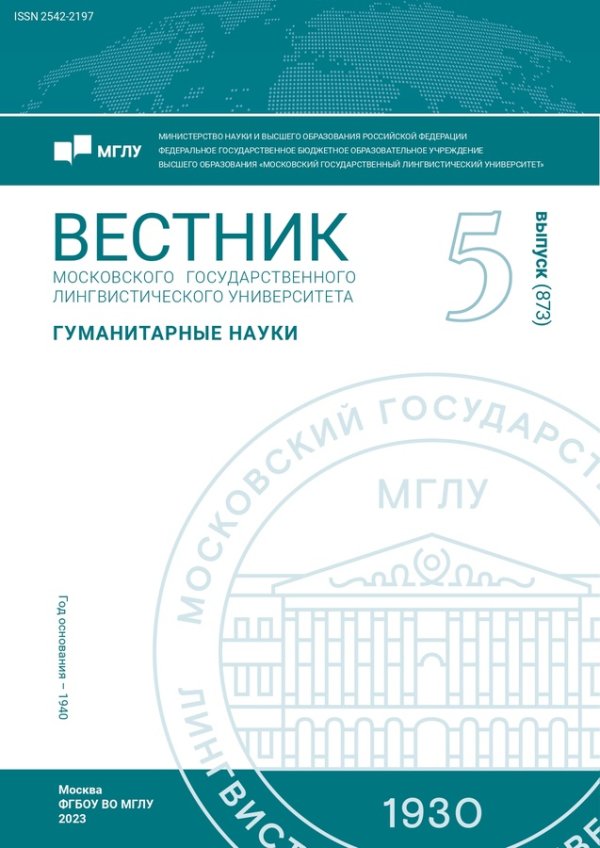
- 作者: Borisova E.S.1, Arsenteva S.V.1
-
隶属关系:
- Moscow State Linguistic University
- 期: 编号 5(873) (2023)
- 页面: 23-29
- 栏目: Linguistics
- URL: https://medbiosci.ru/2542-2197/article/view/351340
- ID: 351340
如何引用文章

详细
The article deals with the problem of the creolized text as means of agitation, advertising and popularization of military-patriotic values and a way to maintain the prestige of the Italian Armed Forces. The research material is a corpus of 100 texts taken from the official Telegram channel of the Italian Ground Forces for the period 2021-2022. The results showed that the texts of the Telegram channel represent a type of social advertising and have an enhanced impact on the audience.
作者简介
Elena Borisova
Moscow State Linguistic University
编辑信件的主要联系方式.
Email: Borisova.ES@linguanet.ru
PhD (Philology), Head of the Italian Language Department, Faculty of Translation and Interpreting
俄罗斯联邦Sofia Arsenteva
Moscow State Linguistic University
Email: sofiya_arsenteva@mail.ru
Postgraduate student of the Italian Language Department, Faculty of Translation and Interpreting,
Lecturer at the Military Training Center and the Italian Language Department
参考
- Lotman, M. Yu. (2000). Semiosfera = Semiosphere. St. Petersburg: Iskusstvo. (In Russ.)
- Vartanova, Ye. L. (2019). Teoriya media: otechestvennyy diskurs = Theory of media: domestic discourse. Faculty of Journalism, MSU, Moscow university press. (In Russ.)
- Dyachkov, M. V. (1987). Kreol’skiye yazyki = Creole languages. Moscow: Nauka. (In Russ.)
- Anisimova, Ye. Ye. (2003). Lingvistika teksta i mezhkul’turnaya kommunikatsiya (na materiale kreolizovannykh tekstov) = Text linguistics and intercultural communication (based on creolized texts). Moscow: Akademiya. (In Russ.)
- Vashunina, I. V. et al. (2020). Kreolizovannyy tekst: smyslovoye vospriyatiye = Creolized text: semantic perception: collective monograph. Moscow: Institute of Linguistics, Russian Academy of Sciences. (In Russ.)
- Kulinich, M. A et al. (2017). Kreolizovannyye teksty v razlichnykh vidakh diskursa: (na materiale angliyskogo yazyka) = Creolized texts in various types of discourse: (on the material of the English language): collective monograph. Samara: SGSPU. (In Russ.)
- Iriskhanova, O. K. (2012). Socio-cognitive approach to multimodality: semiotics of posters. Cognitive studies of language. IYA RAN, Tambov: Izdatel’skij dom TSU, XI, 63–66. (In Russ.)
- Stepanov, Ye. V. (2006). Sotsialnaya reklama v Rossii: genezis, zhanry, evolyutsiya = Social advertising in Russia: genesis, genres, evolution. Moscow: Vest-Konsalting. (In Russ.)
- Lombardi, Vallauri E. (2019). La lingua disonesta = The dishonest language. Bologna: Il Mulino.
- Serianni, L. (2015). Manuale di linguistica italiana. Storia, attualità, grammatica = Manual of Italian linguistics. History, current events, grammar. Milano-Turino: Bruno Mondadori.
- Titova, T. R. (2019). Formy obrashcheniya i titulovaniye v ital’yanskom yazyke: kommunikativnyy shok = Italian forms of address and titles: a cultural shock. Concept: philosophy, religion, culture, 1, 95–103. https://doi.org/10.24833/2541-8831-2019-1-9-95-103 (In Russ.).
补充文件

