






 Email this article
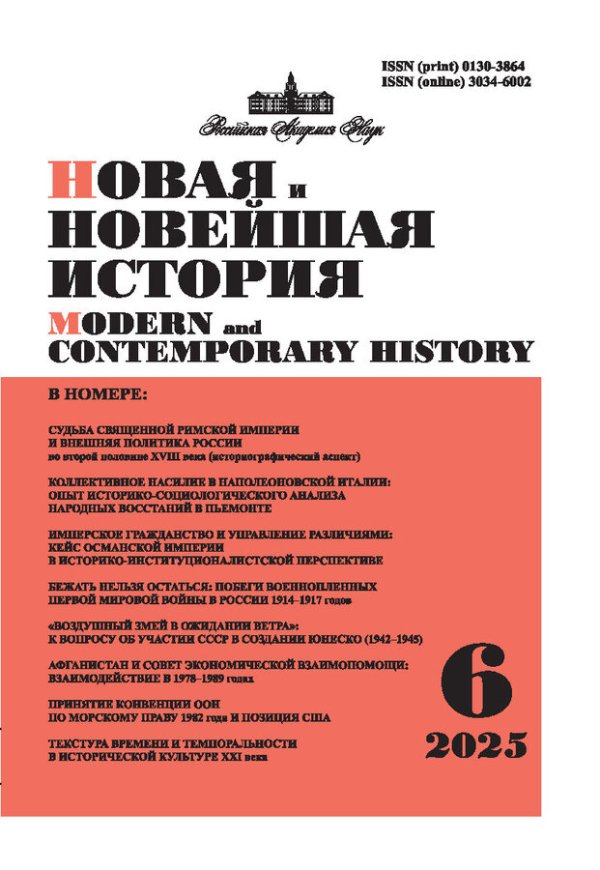
Imperial Citizenship and the Rule of Difference: Historical Institutionalism and the Case of Ottoman Empire
- Authors: Fadeyev I.A.1
-
Affiliations:
- Institute of World History, Russian Academy of Sciences
- Issue: No 6 (2025)
- Pages: 72-90
- Section: Modern history
- URL: https://medbiosci.ru/0130-3864/article/view/360459
- DOI: https://doi.org/10.7868/S0130386425060058
- ID: 360459
Cite item
 Open Access
 Access granted
 Subscription Access

Abstract
This study interrogates the institution of imperial citizenship as a historically sedimented and juridically ambivalent construct, situated at the intersection of law, identity, and imperial governance. Employing the analytical lens of historical institutionalism, it examines the Ottoman Empire, tracing how path-dependent trajectories, critical junctures, and feedback mechanisms gave rise to a dual logic of imperial rule: the codification of differentiated citizenship and the preservation of communal autonomy through legal pluralism. The Ottoman Nationality Law of 1869 serves as a focal point, representing an attempt to redefine subjecthood from confessional allegiance to secular legal membership. Citizenship thus functioned not merely as a legal status but as a colonial apparatus for segmenting populations, regulating allegiance, and constraining political agency. The analysis contends that imperial citizenship in its Ottoman incarnation cannot be understood through the liberal idiom of universal rights, but rather as a mode of governance structured through asymmetry, legal ambiguity, and communal stratification. The institutional legacies of these arrangements – marked by legal pluralism, differential inclusion, and identity-based governance – continue to reverberate within post-imperial polities. Ultimately, imperial citizenship reveals itself less as a neutral legal category than as a historically contingent artifice of rule: simultaneously integrative and exclusionary; universalist in rhetoric, yet particularist in practice.
About the authors
I. A. Fadeyev
Institute of World History, Russian Academy of Sciences
Author for correspondence.
Email: fadeyev.ivan@yahoo.co.uk
ORCID iD: 0000-0003-2202-2246
Scopus Author ID: 57195421011
ResearcherId: AAO-9571-2020
кандидат исторических наук, старший научный сотрудник
Moscow, RussiaReferences
- Palamarchuk A.A., Fadeyev I.A. The Institution of Tithing in the Early Stuart Church of England as an Instrument of Confessional (Self-)Identification // Istoriya. 2022. Vol. 13. Iss. 12 (122). Part 2. DOI: https://doi.org/10.18254/s207987840022818-8 (In Russ.)
- Sdvizhkov D.A. Baltic German Elites: Strategies and Dynamics of Integration in the Eighteenth-Century Russian Empire // Novaya i Novejshaya Istoriya. 2025. № 5. P. 58–74. DOI: https://doi.org/10.31857/S0130386425050059 (In Russ.)
- Taki V.V. The Formation of the Bessarabian Nobility and the Politics of Regional Autonomy, 1810–1820 // Novaya i Novejshaya Istoriya. 2025. № 5. P. 104–120. DOI: https://doi.org/10.31857/S0130386425050089 (In Russ.)
- Urushadze A.T. The Caucasian Viceroy and Regional Elites, 1845–1854: Patronage and Arbitration // Novaya i Novejshaya Istoriya. 2025. № 5. P. 121–133. DOI: https://doi.org/10.31857/S0130386425050098 (In Russ.)
- Abécassis F., Le Gall-Kazazian A. L’identité au miroir du droit. Le statut des personnes en Égypte (fin ХIХe – milieu ХХe siècle) // Égypte/Monde arabe. 1992. № 11. P. 11–38.
- Banko L. The Сreation of Palestinian Сitizenship under an International Mandate: Legislation, Discourses and Practices, 1918–1925 // Citizenship Studies. 2012. Vol. 16. № 5–6. P. 641–655.
- Braude B. Foundation Myths of the Millet System // Christians and Jews in the Ottoman Empire: The Functioning of a Plural Society / eds B. Broude, B. Lewis: in 2 vols. Vol. I. New York; London, 1982. P. 69–88.
- Brower D. Islam and Ethnicity: Russian Colonial Policy in Turkestan // Russia’s Orient. Imperial Borderlands and People, 1700–1917 / eds D.R. Brower, E.J. Lazzerini. Bloomington, 1997. P. 115–135.
- Campos M.U. Revolutionary Citizenship at the End of Empire // Routledge Handbook of Citizenship in the Middle East and North Africa / eds R. Meijer, J.N. Sater, R. Zahra. London; New York, 2020. P. 61–72.
- Capoccia G., Kelemen R.D. The Study of Critical Junctures: Theory, Narrative and Counterfactuals in Historical Institutionalism // World Politics. 2007. Vol. 59. Iss. 3. P. 341–369.
- Çelik Z. Displaying the Orient: Architecture of Islam at Nineteenth-Century World’s Fairs. Berkley; Los Angeles; Oxford, 1992.
- Ceylan E. The Millet System in the Ottoman Empire // New Millennium Perspectives in the Humanities / ed. J. Upton-Ward. Istanbul; Provo, 2002. P. 245–266.
- Constitution nationale des arméniens / trad. de l’arménien sur le document original, par M.E. Prud’homme. Paris, 1862.
- Davison R.H. Reform in the Ottoman Empire, 1856–1876. Princeton, 1963.
- De Weerdt H. Considering Citizenship in Imperial Chinese History // Citizenship Studies. 2019. Vol. 23. № 3. P. 256–276.
- Deringil S. The Well-Protected Domains: Ideology and Legitimation of Power in the Ottoman Empire, 1876–1909. London, 1998.
- Deringil S. “They Live in a State of Nomadism and Savagery”: The Late Ottoman Empire and the PostColonial Debate // Comparative Studies in Society and History. 2003. Vol. 45. № 2. P. 311–342.
- Doss C.M. Colonialism and Communalism: Religion and Changing Identities in Modern India. Abindton; New York, 2024.
- Eissenstat H. Modernization, Imperial Nationalism, and the Ethnicization of Confessional Identity in the Late Ottoman Empire // Nationalizing Empires / eds S. Berger, A. Miller. Budapest; New York, 2015. P. 429–460.
- Eryılmaz B. Osmanlı Devletinde Millet Sistemi. Istanbul, 1992.
- Frazee C. Catholics and Sultans: The Church and the Ottoman Empire, 1453–1923. London; New York, 2006.
- Gaitanos G. Religious Freedom and Millet during the Tanzimat Reform // Theology & Culture. 2022. Vol. 4. P. 57–79.
- Gueye O. Le code de l’indigénat: historique en Afrique francophone, 1887–1946. Dakar, 2019.
Supplementary files
