






 Email this article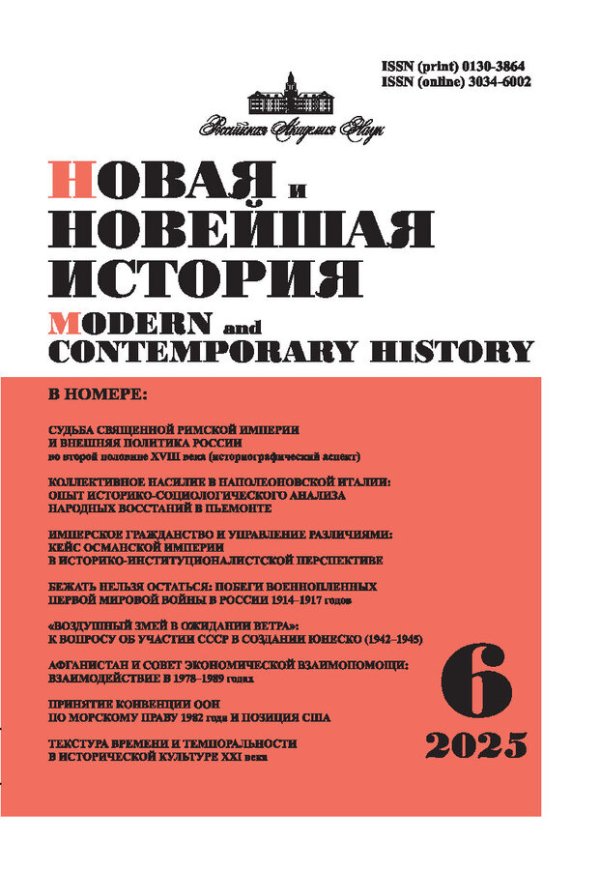
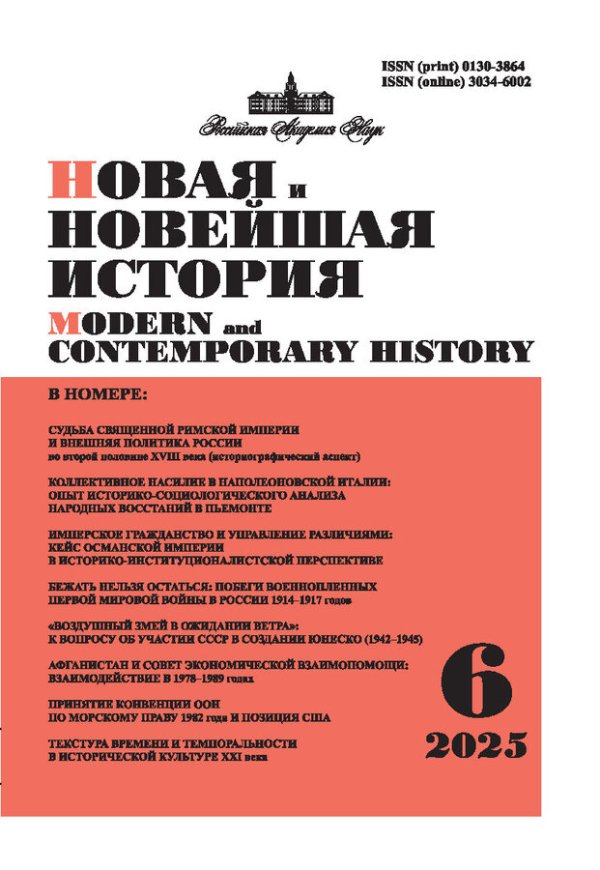
“Escape Impossible to Stay”: Prisoners of War and the Practice of Escape in Russia during the First World War, 1914–1917
- Authors: Surzhikova N.V1
-
Affiliations:
- Institute of History and Archaeology, Ural Branch of the Russian Academy of Sciences
- Issue: No 6 (2025)
- Pages: 102-112
- Section: 20th century
- URL: https://medbiosci.ru/0130-3864/article/view/360463
- DOI: https://doi.org/10.7868/S0130386425060079
- ID: 360463
Cite item
 Open Access
 Access granted
 Subscription Access

Abstract
The article reinterprets the escapes of prisoners of war in Russia during the First World War (1914–1917), challenging the conventional explanation that attributes them solely to weak supervision. It argues that this administrative perspective denies prisoners’ subjectivity and overlooks escape as an expression of agency. Drawing on official documents and contemporary reports, the study examines how the adaptation of prisoners to captivity created new social dynamics that made escape both imaginable and practicable. As prisoners developed inclusive forms of socialisation, communication networks, and mutual support, escape attempts became increasingly systematic. The persistence and recurrence of escape patterns, despite the authorities’ countermeasures, demonstrate that preventing such acts was effectively impossible. Choosing between “to escape, it is impossible to stay” and “to stay, it is impossible to escape,” prisoners asserted their autonomy and forced the Russian authorities to treat them as active participants in the wartime experience. The study also considers the response of the Russian administration and counterintelligence, which redefined escapes as deliberate subversive acts rather than minor breaches of discipline. This shift reveals how the phenomenon of captivity extended the reach of war far beyond the battlefield, drawing diverse social groups into its orbit and reshaping the boundaries between coercion, adaptation, and resistance.
About the authors
N. V Surzhikova
Institute of History and Archaeology, Ural Branch of the Russian Academy of Sciences
Author for correspondence.
Email: snvplus@mail.ru
ORCID iD: 0000-0002-2308-8805
Scopus Author ID: 49964686900
ResearcherId: Q-8162-2016
Yekaterinburg, Russia
References
- Veber M.I., Surzhikova N.V. Prisoners of World War I in the east of Russia: Johan Prince’s view // Dialog so Vremenem. 2014. № 47. P. 340–361. (In Russ.)
- Volkov V.V., Harhordin O.V. Theory of Practice. Saint-Petersburg, 2008. (In Russ.)
- Gabdrafikova L.R., Abdullin H.M. Tatars during the First World War (1914–1918). Kazan, 2015. (In Russ.)
- Kirmel’ N.S. “...Japanese laundresses and the barbers opened... many stores for the purpose of conspiracy espionage” // Military History Magazine. 2001. № 3. P. 54–59. (In Russ.)
- Kiselev D.V. “Dubious Germans”: agents and prisoners of War of Central Powers in Manchuria during World War I // Russia and The Pacific. 2015. № 2. P. 121–138. (In Russ.)
- Kozlov D.V., Anufriev A.V. “I’ve Planned to Escape”: The Possibilities of an Anthropological Approach to the Phenomenon of Escape from Captivity during the First World War // The Dichotomy of War and Peace: Border Regions in Turning Points in History. A Collection of Materials from the All-Russian Scientific and Practical Online Conference. Pskov, 2020. P. 128–139. (In Russ.)
- Ljublinskij P.I. March Amnesties. Petrograd, 1917. (In Russ.)
- Nagornaja O.S. The Stigma of Betrayal: Russian Captives of the First World War in the Perception of Military Command and Public Institutions (1914–1917) // Problems of Russian History. 2006. № 1. P. 289–308. (In Russ.)
- Novikova I.N. About the escapes of German and Austrian prisoners of war through Finland during the First World War // St. Petersburg and the Nordic countries. 2007. № 8. P. 168–183. (In Russ.)
- Poznahirev V.V. Escape from Russian Captivity in the 18th – early 20th century: Classification, Determination, Responsibility (as exemplified by Turkish Prisoners of War) // Military Legal Journal. 2015. № 9. P. 23–27. (In Russ.)
- Poznahirev V.V. Turkish Prisoners of War and Civilian Prisoners in Russia in 1914–1924. Saint-Petersburg, 2014. (In Russ.)
- Russia in the World War of 1914–1918: (In Figures). Moscow, 1925. (In Russ.)
- Sibgatullina A.T. Contacts of the Muslim Turks of the Russian and Ottoman Empires at the Turn of the 19th–20th Centuries. Moscow, 2010. (In Russ.)
- Sinichenko V.V. In the Interests of Russia: From the Foreign Agents of the Police Department to the Foreign Residencies of the United State Political Directorate (1913–1930). Moscow, 2024. (In Russ.)
- Surzhikova N.V. Conceiving the Camp: The Institutional Environment of the 1914–1917 Russian Captivity and the Problem of Its Articulation // URL: https://legacy.inion.ru/index.php?page_id-522 (access date: 18.03.2025). (In Russ.)
- Tjurin A.O. Security and Supervision of War Prisoners in the Astrakhan region in the World War Years // Ivzestia of the Volgograd State Pedagogical University. 2016. № 9–10 (113). P. 179–187. (In Russ.)
Supplementary files
