





 Email this article
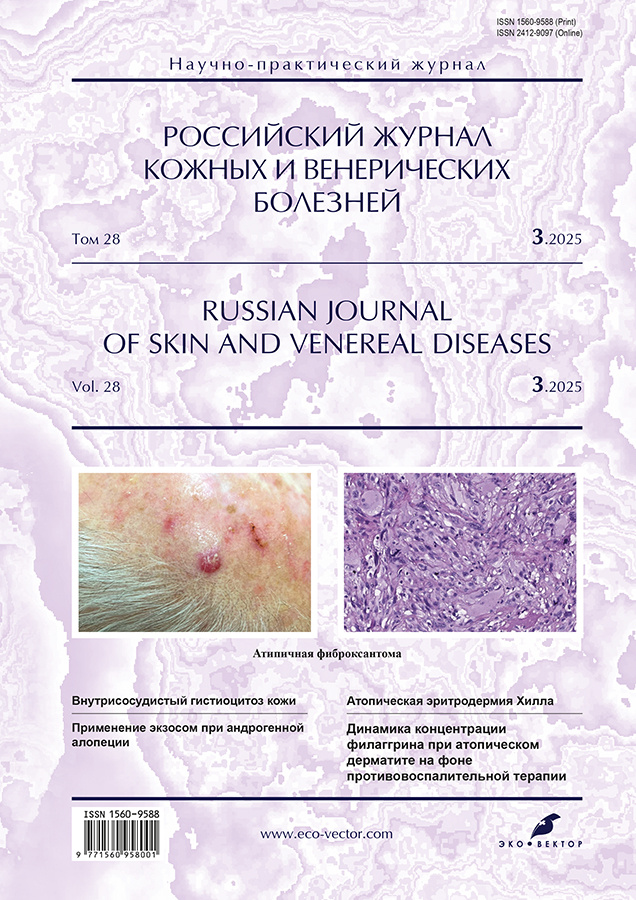
 Intravascular histiocytosis of the skin
- Authors: Bulanov D.V.1, Podverbnaya J.S.1
-
Affiliations:
- The Russian National Research Medical University named after N.I. Pirogov
- Issue: Vol 28, No 3 (2025)
- Pages: 293-300
- Section: DERMATOLOGY
- URL: https://medbiosci.ru/1560-9588/article/view/313076
- DOI: https://doi.org/10.17816/dv653977
- EDN: https://elibrary.ru/TGCNMF
- ID: 313076
Cite item
 Open Access
 Access granted
 Subscription Access

Abstract
Intravascular histiocytosis is a rare dermatologic condition characterized by pathological vascular dilation and accumulation of histiocytes within the lumen of blood vessels. Despite its rarity, challenges in diagnosis and treatment persist due to the absence of standardized protocols and a limited understanding of the disease pathogenesis.
A key initiating factor is damage to the vascular wall, promoting histiocyte migration and proliferation within vessels. This process may be triggered by infections, cardiovascular dysfunction, hepatic or renal pathology. However, some cases occur in individuals without comorbidities, suggesting the involvement of unidentified triggers or genetic predispositions.
Clinical manifestations vary and include ill-defined erythematous to violaceous patches, plaques, nodules, and papules, most commonly affecting the trunk and extremities. The lesions may also present as hemorrhagic nodules and papules, complicating the differential diagnosis with other dermatoses. The condition’s rarity and non-specific presentation often result in misdiagnosis and inappropriate treatment, worsening the clinical course.
Currently, there is no universal treatment protocol for intravascular histiocytosis. Corticosteroids are frequently used, but their efficacy and long-term outcomes remain poorly defined.
This article describes a clinical case of a female patient presenting with papular eruptions on the neck and scalp. The diagnosis was confirmed by dermatoscopy and histological examination of a skin biopsy. The case highlights the need for further research to establish standardized diagnostic and therapeutic strategies for intravascular histiocytosis.
Keywords
Full Text
##article.viewOnOriginalSite##About the authors
Dmitriy V. Bulanov
The Russian National Research Medical University named after N.I. Pirogov
Email: dbulanov81@gmail.com
ORCID iD: 0009-0005-3772-6643
SPIN-code: 2641-6658
MD, Cand. Sci. (Medicine), Associate Professor
Russian Federation, MoscowJulia S. Podverbnaya
The Russian National Research Medical University named after N.I. Pirogov
Author for correspondence.
Email: julia_123_julia_123@mail.ru
ORCID iD: 0009-0002-9236-6714
SPIN-code: 1653-2617
Russian Federation, Moscow
References
- Demirkesen C, Kran T, Leblebici C, et al. Intravascular/intralymphatic histiocytosis: A report of 3 cases. Am J Dermatopathol. 2015;37(10):783–789. doi: 10.1097/DAD.0000000000000257
- O’Grady JT, Shahidullah H, Doherty VR, Al-Nafussi A. Intravascular histiocytosis. Histopathology. 1994;24(3):265–268. doi: 10.1111/j.1365-2559.1994.tb00519.x
- Rieger E, Soyer HP, Leboit PE, et al. Reactive angioendotheliomatosis or intravascular histiocytosis? An immunohistochemical and ultrastructural study in two cases of intravascular histiocytic cell proliferation. Br J Dermatol. 1999;140(3):497–504. doi: 10.1046/j.1365-2133.1999.02717.x
- Asagoe K, Torigoe R, Ofuji R, Iwatsuki K. Reactive intravascular histiocytosis associated with tonsillitis. Br J Dermatol. 2006;154(3):560–563. doi: 10.1111/j.1365-2133.2005.07089.x
- Catalina-Fernández I, Alvárez AC, Martin FC, et al. Cutaneous intralymphatic histiocytosis associated with rheumatoid arthritis: Report of a case and review of the literature. Am J Dermatopathol. 2007;29(2):165–168. doi: 10.1097/01.dad.0000251824.09384.46
- Lichtenstein L. Histiocytosis X; integration of eosinophilic granuloma of bone, Letterer-Siwe disease, and Schüller-Christian disease as related manifestations of a single nosologic entity. AMA Arch Pathol. 1953;56(1):84–102.
- Hamre M, Hedberg J, Buckley J, et al. Langerhans cell histiocytosis: An exploratory epidemiologic study of 177 cases. Med Pediatr Oncol. 1997;28(2):92–97. doi: 10.1002/(sici)1096-911x(199702)28:2<92::aid-mpo2>3.0.co;2-n
- McClain K, Jin H, Gresik V, Favara B. Langerhans cell histiocytosis: Lack of a viral etiology. Am J Hematol. 1994;47(1):16–20. doi: 10.1002/ajh.2830470104
- Yu RC, Chu C, Buluwela L, Chu AC. Clonal proliferation of Langerhans cells in Langerhans cell histiocytosis. Lancet. 1994;343(8900):767–768. doi: 10.1016/s0140-6736(94)91842-2
- Lim KP, Milne P, Poidinger M, et al. Circulating CD1c+ myeloid dendritic cells are potential precursors to LCH lesion CD1a+CD207+ cells. Blood Adv. 2020;4(1):87–99. doi: 10.1182/bloodadvances.2019000488
- Badalian-Very G, Vergilio JA, Degar BA, et al. Recurrent BRAF mutations in Langerhans cell histiocytosis. Blood. 2010;116(11):1919–1923. doi: 10.1182/blood-2010-04-279083
- Berres ML, Lim KP, Peters T, et al. BRAF-V600E expression in precursor versus differentiated dendritic cells defines clinically distinct LCH risk groups. J Exp Med. 2014;211(4):669–683. doi: 10.1084/jem.20130977
- Cui L, Zhang L, Ma HH, et al. Circulating cell-free BRAF V600E during chemotherapy is associated with prognosis of children with Langerhans cell histiocytosis. Haematologica. 2020;105(9):e444–447. doi: 10.3324/haematol.2019.229187
- Okamoto N, Tanioka M, Yamamoto T, et al. Intralymphatic histiocytosis associated with rheumatoid arthritis. Clin Exp Dermatol. 2008;33(4):516–518. doi: 10.1111/j.1365-2230.2008.02735.x
- Requena L, El-Shabrawi-Caelen L, Walsh SN, et al. Intralymphatic histiocytosis. A clinicopathologic study of 16 cases. Am J Dermatopathol. 2009;31(2):140–151. doi: 10.1097/DAD.0b013e3181986cc2
- Abuawad YG, Diniz TA, Kakizaki P, Valente NY. Intravascular histiocytosis: Case report of a rare disease probably associated with silicone breast implant. An Bras Dermatol. 2020;95(3):347–350. doi: 10.1016/j.abd.2019.04.016
- Requena L, Fariña MC, Renedo G, et al. Intravascular and diffuse dermal reactive angioendotheliomatosis secondary to iatrogenic arteriovenous fistulas. J Cutan Pathol. 1999;26(3):159–164. doi: 10.1111/j.1600-0560.1999.tb01822.x
- Rhee DY, Lee DW, Chang SE, et al. Intravascular histiocytosis without rheumatoid arthritis. J Dermatol. 2008;35(10):691–693. doi: 10.1111/j.1346-8138.2008.00544.x
- Aung PP, Ballester LY, Goldberg LJ, Bhawan J. Incidental simultaneous finding of intravascular histiocytosis and reactive angioendotheliomatosis: A case report. Am J Dermatopathol. 2015;37(5):401–404. doi: 10.1097/DAD.0000000000000244
- Takiwaki H, Adachi A, Kohno H, Ogawa Y. Intravascular or intralymphatic histiocytosis associated with rheumatoid arthritis: A report of 4 cases. J Am Acad Dermatol. 2004;50(4):585–590. doi: 10.1016/j.jaad.2003.09.025
- Mazloom SE, Stallings A, Kyei A. Differentiating intralymphatic histiocytosis, intravascular histiocytosis, and subtypes of reactive angioendotheliomatosis: Review of clinical and histologic features of all cases reported to date. Am J Dermatopathol. 2017;39(1):33–39. doi: 10.1097/DAD.0000000000000574
- Nishie W, Sawamura D, Iitoyo M, Shimizu H. Intravascular histiocytosis associated with rheumatoid arthritis. Dermatology. 2008;217(2):144–145. doi: 10.1159/000135630
- Gorlanov IA, Zaslavsky DV, Mineyeva OK, et al. Langerhans cell histiocytosis (histiocytosis X): A case study. Vestnik dermatologii i venerologii. 2013;(1):51–55. EDN: PWLEED
- Bakr F, Webber N, Fassihi H, et al. Primary and secondary intralymphatic histiocytosis. J Am Acad Dermatol. 2014;70(5):927–933. doi: 10.1016/j.jaad.2013.11.024
- Mensing CH, Krengel S, Tronnier M, Wolff HH. Reactive angioendotheliomatosis: Is it ‘intravascular histiocytosis’? J Eur Acad Dermatol Venereol. 2005;19(2):216–219. doi: 10.1111/j.1468-3083.2005.01009.x
Supplementary files


