




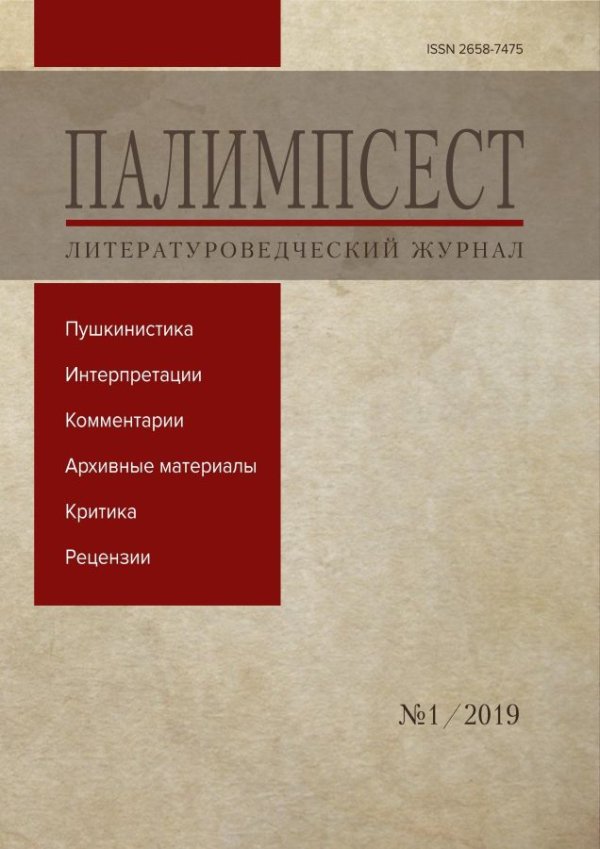
No 1 (2019)

PUSHKINISTICS
«TO ONE EPISODE FROM THE LIFE OF "MAYOR" KOVALEV. PUSHKIN AND GOGOL ON THE PAGES OF THE JOURNAL «SOVREMENNIK» (1836 г.)
Abstract
The article traces how the Caucasus theme develops on the pages of the St. Petersburg journal Sovremennik; in particular, we discuss the features of public service on the outskirts of the Empire. The purpose of the article is to study the works of Russian literary classics to identify the motives, defined by the so-called "Decree on examinations" (1809), which established the foundations of promotion in ranks in civilian institutions. The study is based on the material of travel notes “Journey to Arzrum during the campaign of 1829” by A.S. Pushkin and the story "The Nose" by N.V. Gogol, published respectively in the first and third volumes of Sovremennik. It is noted that in “Journey to Arzrum” Pushkin focuses on the attractiveness of the service in the Caucasus for titular counselors, who saw it as an opportunity to obtain “the so coveted” Class-VIII rank (collegiate assessor) without passing examination tests. This fragment of "Journey..." refers to the satirical poem by A.N. Nakhimov "Elegy" (1809), which indicates Pushkin's hostility towards the universal pursuit of ranks. N.V. Gogol in his fantastic constructions also takes into account the effect of the aforementioned “Decree on examinations”. Thus, the “major” Kovalev from the story “The Nose” is called the “Caucasian collegiate assessor”, which for an initiate reader signals that the protagonist has been accepted into a unified official body, where the significance of a personality is determined by their place on the corporate ladder, where getting the rank becomes the meaning of life, and affinity is understood not as a natural property, but as a state phenomenon. The study stresses the fact that A.S. Pushkin, just like N.M. Karamzin before him, advocated the abolition of exams for ranks. We conclude that in Pushkin’s Sovremennik the image of the Caucasus loses the romantic aura traditional for the “golden age” and is viewed in a social context, filled with meanings that are more complex. Thus, the article offers an original research direction of Pushkin's Sovremennik, revealing its previously unexplored features.
Palimpsest. Literary journal. 2019;(1):9-22
 9-22
9-22


« AND WITH YOUR WORD IGNITE MEN'S HEARTS»: SEARCH OF BIBLICAL PARALLELS
Abstract
The author evolves an idea of Eucharistic interpretation of the Prophet by A.S. Pushkin. In the paper are adduced new biblical and hymnographycal contexts, basing on which the author proposes a variant of interpretation of gnomic ending of the poem. Traditionally, the text of the verse is derived ecstatic visions of prophets Isaiah (Isaiah 6; 50,4–6) and Ezekiel (Ezekiel 1, 36,24–26), also single parallels is quoted from prophecies of Jeremiah (Jeremiah 1,9; 5,14) and Daniel (Daniel 10) etc. some researchers detect precedents in the Koran. Only in the late 20th century scientists and commentators noticed connection of Pushkin’s work with texts of New Testament and Christian hymnography. Continuing interpretation by the New Testament, the author places high emphasis on textual текстуальным relations of the verse with Eucharistic hymnography. Attraction of series of new parallels permits not only to позволяет assert particular character of evolution of the Prophet, but also thoroughly comment on the most important metamorphosis – substitution of heart, which, in opinion of the researcher, serve as clue to comprehension of last phrase of the text.
Palimpsest. Literary journal. 2019;(1):23-33
23-33
Far Eastern Text of A.S. Pushkin
Abstract
In this work, the author focuses on A. S. Pushkin's interest to the Far East and to the problem of its development by Russian pioneers expressed in several works on respective topics. The purpose of the article is to identify the reasons why the poet keeps returning to the “Kamchatka” themes and to clarify possible creative ideas related to the development of the theme of the conquest of the far Trans-Urals. The study was based on the materials of little-studied unfinished sketches written by A.S. Pushkin in 1836-1837, written while he was reading the notes of the participant of the Second Kamchatka Expedition S.P. Krasheninnikov called "Description of the Land of Kamchatka" (1755). A comparative analysis of three well-known fragments ("About Kamchatka", "Kamchatka Affairs (from 1694 to 1740)", "Outline of the Beginning of an Article about Kamchatka") shows that Pushkin was interested not so much in ethnographic and natural-science information about Kamchatka, as in the history of its development by the Cossacks, uneasy relationship between colonizers and indigenous people. The plots chosen by the writer have something in common with the two main themes of Russian history for him – the reforms of Peter the Great and the Cossack freemen. The stylistic heterogeneity of the sketches examined suggests that Pushkin intended to write both documentary and fictional works about the accession of Kamchatka to Russia. Probably, such close attention to the Far East is caused not only by the poet’s interest in national history but also by some biographical reasons, including his unfulfilled desire to visit the eastern lands. The author makes a conclusion about the influence of A.S. Pushkin for the next generation of writers who have repeatedly addressed the “Far Eastern theme”, which continues to remain in great demand to this day.
Palimpsest. Literary journal. 2019;(1):34-42
34-42
INTERPRETATIONS
M.Yu. LERMONTOV AND A.P. SUMAROKOV: POSSIBLE CONVERGENCIES
Abstract
The article reveals one of the aspects of the “Lermontov and Classicism” problem, which to this day remains in the unexplored category. The subject of the study is the possible points of convergence of the artistic systems of A.P. Sumarokov and M.Yu. Lermontov. The purpose of the article is to identify and analyze facts that indicate the direct or indirect perception by M. Yu. Lermontov of ideas, images, motives, features of the poetic organization of works by A.P. Sumarokov. Scholars name two possible parallels between Lermontov’s work and Sumarokov’s tradition: the first is connected with the attempts of writers to reproduce the metrics of folk poetry, the second – with the appeal to the form of the Poet’s dialogue with an unidentified interlocutor. In Lermontov's poem “Journalist, reader, and writer” this form allows readers to identify the consonance of the author’s understanding of the poet’s purpose and the poetic Word, which should actively influence the society and human consciousness, with Sumarokov’s position expressed in the poem “Piit and His Friend”. Using the methods of comparative, comparative historical and transtextual analysis, the author also discovers a number of other “convergences” of the two artistic systems. First, it is their interest in the Hamlet theme. Second, their semantic closeness of interpretations of the image of the wave and the "marine theme". It is suggested that the indirect source of the poem “Waves and People” for Lermontov could be Sumarokov’s miniature “Sea and Eternity”. Destroying the classic interpretation of the image of the sea and its associated rivers, A.P. Sumarokov finds it as a symbol of eternity, establishing a similarity between the flow of waves and the unidirectional movement of human life. M.Yu. Lermontov, refusing the idea of directional movement and drawing the parallel between the coldness of the waves and the coldness of human souls, which Sumarokov lacks, nevertheless addresses the same motive for the transience of life and the inevitability of death. Thus, in the text of the poem "Waves and People" by M. Yu. Lermontov's text we can see the emergence of miniatures by A.P. Sumarokov, which may serve as new significant evidence of the dialogical connection between the two poets.
Palimpsest. Literary journal. 2019;(1):43-57
43-57
Sadovnikov Paradox
Abstract
The article presents the analysis of the ballad by D.N. Sadovnikov "Iz-za ostrova na strezhen (Stenka Razin Song) ..." (1883). The aim of the study is to identify the features of the interpretation of the famous plot about Stenka Razin, which characterize the ballad, and to establish the reasons for the demand for this work at the turn of the XIX-XX centuries. The study uses comparative and systematic methods, methods of plot-motive, contextual, and transtextual analysis. The author proves that the storyline of Sadovnikov’s ballad was based on the story by J. Struys about the capture and murder of the “Persian princess”, set out in the monograph by N.I. Kostomarov "Riot of Stenka Razin" (1858). The image of the “merry and intoxicated” ataman Stenka Razin, who drowned his beloved prisoner in the Volga in order to strengthen his influence on the “Cossack fraternity”, turned out to be consonant with the ideals of the “criminal underworld” that had penetrated the general Russian culture in the late XIX – early XX centuries and underpinned by the "spirit of revolutionism." As a result, the ballad of Sadovnikov, set to music, started being perceived as a folk song, and was later adapted for pop, theater, and cinema, became the basis of V. Kamensky’s poem “Folk Heart – Stenka Razin”. A.S. Pushkin in the lyric cycle "Songs about Stenka Razin" (1826) interprets the same plot differently: the poet developed the philosophical motive of the sacrifice made by the protagonist after a long reflection. However, the work of Pushkin did not enjoy such a massive reader response. The author concludes that the mass popularity of the ballad by D.N. Sadovnikov was due to its correspondence to the “banditesque” public sentiments of the beginning of the 20th century, while the lyrical cycle of A.S. Pushkin, due to his proximity to genuine folklore poetics and philosophical depth, turned out to be too complicated for the readers.
Palimpsest. Literary journal. 2019;(1):58-74
58-74
COMPOSITE MARKERS OF MENAJNY CODE IN ANDREY PLATONOV'S STORY “THE THIRD SON”
Abstract
Consideration of a literary work in a system of contexts has long become a common literary practice. The menajny code as one of the tools, which include the text in the field of transtextual connections, was proposed by the author several years ago and tested against many works of Russian literature, among which Chetyi-Minei became one of the conceptual texts. The article offers an analysis of the story by Andrei Platonov “The Third Son” from the point of view of the implementation in it of a menajny-structured system of characters – a family of three generations gathered for the mother’s funeral. The purpose of the article is to “decipher” the menajny code contained in the story and disclose, on the basis of the data obtained, one of the implicit aspects of the idea of the text. The uniqueness of the chosen work is that while the names of the characters occupy the key position in the menajny code, the story “The Third Son” has no names of the characters or other signs of the "reality" of the situation. Considering the maximum abstraction of narration, the composition of the story characterized by a multi-vertex system of images becomes the main marker of menajny codification. The six brothers, despite the difference in their destinies, are equal in their devotion to their family, in their spiritual strength. They are a continuation of the deceased mother, in whose image hagiographic motifs can be traced. The third son plays the central role in the novel due to the fact that the meaning of what is happening is concentrated in his image: he brings a small daughter to the parental home, becoming a symbol of the bond of generations, stops the inappropriate fun of the brothers; and his fainting, which can be seen as a posthumous miracle of the mother, makes the other sons experience grief and discover new life truths. The author comes to the conclusion that by attracting the readers as a full-fledged generators of meaning, Platonov frees them from predetermined negative evaluations, allowing them to understand the true biblical significance of the interaction of the brothers on their way to comprehending existential meanings.
Palimpsest. Literary journal. 2019;(1):75-87
75-87
NATALIYA KLIMOVA'S IMAGE IN THE LITERARY INTERPRETATION BY M.OSORGIN AND V.SHALAMOV
Abstract
The author analyzes the image of N.S. Klimova in M. Osorgin's novels “The Witness of History”, “The Book of Ends”, as well as in the story “Golden Medal” by V. Shalamov. The purpose of the study is to compare two artistic concepts of the image of the same real historical person. Similarities are revealed in several important aspects of the image of the protagonist. In particular, both authors portray her as a girl with a stormy temperament, comparing it with the force of nature. The authors also emphasize the protagonist's tendency to melodramatize, and while M. Osorgin sees Natasha's growing into the role of a fearless revolutionary as a result of internal efforts, V. Shalamov thinks that this perception is possible only for the “external” consciousness, but not for the protagonist herself. Both writers focus their attention on the unchanging tragedy of the laws of history, which destroy lives, and on the inevitability of the birth of a “revolutionary spirit” in a person during crisis periods. There are also differences in the approach to the image of the personality of N.S. Klimova. M. Osorgin shows the evolution of the protagonist's worldview: having discovered the ontological essence of the world, she is disappointed in the revolutionary struggle, whereas V. Shalamov maintains her image intact in its romantic brightness. The motivations of the protagonist’s actions are different: for M. Osorgin, she strives for an extraordinary act, for V. Shalamov – for self-sacrifice for the benefit of the people. The difference in moral evaluations of the protagonist’s activity is also significant: in M. Osorgin’s novels, the author gives an ambivalent assessment of Natasha’s actions, while V. Shalamov gives the protagonist an unambiguously positive evaluation. Therefore, we can conclude that these differences are associated with the revolutionary experience of the writers and their perception of the past, the symbol of which they both see in N.S. Klimova: while M. Osorgin eventually finds the inconsistency in the old ideals, V. Shalamov keeps perceiving the revolution and its heroes in the romantic aura.
Palimpsest. Literary journal. 2019;(1):88-102
88-102
THE IMPORTANCE OF "GOGOL’S TEXT" IN DRAMATURGY OF N.V. KOLADA
Abstract
The textual expression of the dialogical interaction between N.V. Kolyada and N.V. Gogol on the example of four "Gogol's" plays by Kolyada ("Old World Love", "Ivan Fedorovich Shponka and His Aunt", "Box", "Dead Souls"). The aim of the article is to analyze the forms and tasks of application of the “Gogol text” and its connection with the “author's word” in the works of N.V. Kolyada. In this article, we prove that the regular appeal of N.V. Kolyada to the texts of N.V. Gogol carried out in the form of quotations, reminiscences or allusions, is due to the similarity of the artistic methods of the two writers, based on the closeness of their aesthetic, axiological and ontological ideas. At the same time, Kolyada does not reproduce the aesthetic and ideological system of N.V. Gogol but recreates it from scratch, using the pretext as a means of identifying the meanings embedded in it, and as material for the generation of new meanings. On the one hand, N.V. Kolyada exposes Gogol's poetry of the “grim carnival” to artistic rethinking: referring to the means of “areal speech”, mask and disguise motives, grotesque images; using the principles of repeatability and illogicality, the playwright “reveals the technique”, makes obvious the presence of chaos, destructive surreal beginning, veiled in the pretext. On the other hand, Kolyada does not isolate the depicted world from the highest moral values that protagonists can acquire by going through the conditionally-symbolic awakening of the soul: this circumstance explains the complete replacement of the “other word” by “their own” in the final scenes of these plays. It is concluded that the analysis of the intertextual interaction between N.V. Kolyada and N.V. Gogol is an effective way of understanding the axiological and ontological foundations of both the "Gogol" plays of the playwright and his other works.
Palimpsest. Literary journal. 2019;(1):103-114
103-114
Horatian Understanding of Painting in the Poem by Maria Stepanova
Abstract
A poem by Maria Stepanova “Kto tot yunosha bil, Pirra, priznaysia mne!.. (Who was that young man, Pyrrha, confess to me!)” is both a gloss and at the same time the permissive interpretation of Ode I, V by Horace – the work of the Roman poet that reveals both versions of the origin of painting: as a development of tributary signs about rescue and as a reflection of experience of a pleasant place. The purpose of the article is to establish the basis on which the Goratinian imagery was combined in M. Stepanova’s poem with a sapphic, general theme and idea of the poem, as well as the source and methods of representing the sensation of sublime experience in it. Methodologically it is necessary to refer to the techniques of studying ecphrasis as a way of turning the depicted images into plot effects, the study of those properties of the poetics of the odes that give stability to its variations, and the interpretation of the poem in the context of M. Stepanova’s entire work, which is characterized by a certain set of values and stylistic rules. The authors note that Horace compares the version of the origin of the visual arts with a complex plot of love temptation as catastrophic and inevitable, whereas Stepanova interprets the temptation as a sublime experience. While Horace resolves the conflict by dialogue, Stepanova uses figurativeness of inevitable being after a catastrophe. We prove that Stepanova's plot development is rooted in the ancient understanding of the theophany, the phenomenon of a deity, which allows one to see a traumatic experience behind the brilliant facade of antiquity. It is concluded that Stepanova deeply perceives the prerequisites of ancient culture and contextualizes them within the modern gender and traumatic perspectives, which makes it possible to recreate the standard of ecphrasis in modern poetry in a new way.
Palimpsest. Literary journal. 2019;(1):115-124
115-124
COMMENTS
From Commentary to Author Songs. Three Notes
Abstract
The author of this article comments on the author songs by Mikhail Ancharov (“Pykhom klubit par…”), Yuri Vizbor (“Spokoino, druzhische, spokoino! ..”) and Vladimir Vysotsky (“Nikakoi Oshibki”). The subject of the study is the intertextual relations that exist between these works and the poetic texts of other authors, and its goal is to identify possible literary sources of the songs mentioned. We prove that M. Ancharov’s song “Pykhov klubit par ...” was created under the influence of B. Kornilov’s poems “Forest” and “Forest House”. This is evidenced by the similarity of lyrical situations (in the “Forest” Kornilov's lyrical protagonist also participates in a duel with a hostile nature, which takes an allegorical form), the actualization of the motif of hunting in the song of Ancharov, rhythmic consonance, general pathos and lyrical atmosphere, which bring "Pykhom klubit par ..." and "Forest House" closer together. The author confirms the conclusion of N.A. Bogomolov about the presence of a genetic link between the song by Yu. Vizbor “Spokoino, druzhische, spokoino!” and the poem by N.S. Gumilyov "The Worker". The popularity of Gumilyov's creativity among the poets of the “thaw” generation, the presence of images and lyrical motifs of "The Worker" in the early verses of Vizbor, the presence of reminiscences from another poem by Gumilyov – "Giraffe" in "Spokoino, druzhische, spokoino!.." serve to prove this conclusion. The author offers a possible source of V.Nysotsky's song “No Error”, which was not previously considered by scholars – the poem of the Oberiu-poet N. Oleinikov and playwright E. Schwartz “On the birthday of the surgeon Grekov”. The text of Vysotsky’s song and the poem are brought together by a lyrical situation based on “estrangement” arising in the consciousness of the protagonist-patient, as well as a general poetic size, trochaic tetrameter, corresponding to an energetic change of scenery and an ironic intonation of works. This version is also supported by Vysotsky’s confirmed interest in Oleinikov’s poetry in 1975–76.
Palimpsest. Literary journal. 2019;(1):125-139
125-139
ARCHIVE MATERIALS
«Those days when on the THRESHOLD OF “The paradise…”»: Boris Sadovskoy and his poem «Veniamin Ternovsky»
Abstract
In accordance with the plans to prepare a scientific collection of B.A. Sadovskoy's works, the author is working to acquaint readers with previously unknown texts of the poet. This article provides the first publication of the poem "Veniamin Ternovsky", referring to the initial period of Sadovskoy's literary activity. The subject of the research is the creative history and the prototypical basis of this work. The purpose of the article is to create a detailed commentary on the poem, reflecting its connection with the biography and work of the poet, as well as with Pushkin’s literary context. The study is based on the materials of the manuscript of the poem, the memoirs and the epistolary of its curator, Moscow philologist M.A. Yakhontova, published collections of poems by Sadovskoy. It was discovered that the prototypes of the characters in the poem were real individuals, whom Sadovskoy met in “Rai (Paradise)” — the Vladimir Realschule of Nizhny Novgorod, a favorite place of young people of pre-revolutionary years. Among them, there was Lydia Glazova, who played a special role for the poet, and to whom Sadovskoy dedicated a number of poems. Some of them are published for the first time. The author emphasizes the importance of “Veniamin Ternovsky” for Sadovskoy's creative self-determination: the poem revealed such features of the poet’s original style as a satirical-parody syllable, a caricature style, grotesque, the use of a literary game and a mask. Numerous intertextual links of the poem with “Eugene Onegin” by A.S. Pushkin testify of Sadovskoy’s attention to Pushkin’s literary heritage, an interest in which has become the general trend of cultural life at the turn of the 19th and 20th centuries. The work is of undoubted interest to the researchers of the work of B.A. Sadovskoy, due to the fact that it deals with the aesthetic evolution of his poetry, as well as for specialists in the field of literary and historical regional studies.
Palimpsest. Literary journal. 2019;(1):140-172
140-172
CRITICISM
How to Navigate in the Sea of Modern Literature?
Abstract
The article is devoted to such significant issues as the status of a critic in the modern literary process and the influence of the publishing business on building writing hierarchies and reputations. The purpose of the article is to establish the current trends in the development of the literary process and to determine the purpose of literary criticism today. It is emphasized that endowing a literary work with a certain aesthetic value is being replaced today by promoting a book product through various marketing strategies aimed solely at making a profit. In this regard, the role of critics, who are now becoming serial reviewers, is to regularly perform the managerial function of an employee of a text promotion corporation. Today, the publishing business has a decisive influence on the literary process and focuses on the transformation of book production into the service sector, on the mass character of titles, not their circulation. As a result, the tradition of systematic communication between the author and the reader is being destroyed, the sacral status of the text is being profaned, and literature loses its natural hierarchy and becomes saturated with artificially created and monopolized literary reputations and brands. The article proves the need to preserve the active role of professional literary criticism as an activity in the formation of the spiritual paradigm of society, in identifying timeless value criteria for the selection of texts, which is now replaced by the compilation of “recommendation lists” and a simple exchange of impressions. It is concluded that under these conditions, the main task of criticism is the discovery of modern literature for the reader, the initiation of a dialogue that will allow to move from the consumption of a book product to understanding and generation of meanings of a work of art.
Palimpsest. Literary journal. 2019;(1):173-180
173-180
RECENCES
Encyclopedic Dictionary Literary Yekaterinburg
Abstract
The review covers a unique product by scholars of Yekaterinburg – encyclopedic dictionary " Literary Ekaterinburg" (2016). The purpose of the article is to provide a system characteristic of its structure, specificity, subject of articles. It is noted that the dictionary is intended to reflect the literary life of Yekaterinburg in its entirety, to capture it in both synchronic and diachronic aspects. The main advantage of the publication is its informativeness: the dictionary contains not only biographical information about the participants of the Yekaterinburg literary process, but also bibliographic information that covers both the literary and sociocultural reality of the city. Despite the fact that the principle of presenting knowledge in an encyclopedic dictionary does not traditionally imply the formation of a whole picture, Literary Yekaterinburg presents a single idea of the literary process of Yekaterinburg. This is due to the representation of literature as a living, developing phenomenon and as a universally significant cultural event that transcends the region’s borders and is written in the history of the country. It is concluded that “Literary Yekaterinburg” illustrates an important tendency, according to which the usual understanding of the term “literary province” becomes irrelevant, giving way to looking at regional literature as a bright, original phenomenon that needs to be studied. The review is of undoubted interest for philologists who study the phenomenon of regional literature in general or of Yekaterinburg literature in particular, as well as for all readers who want to get an idea of the encyclopedic dictionary “Literary Yekaterinburg”.
Palimpsest. Literary journal. 2019;(1):181-184
181-184