



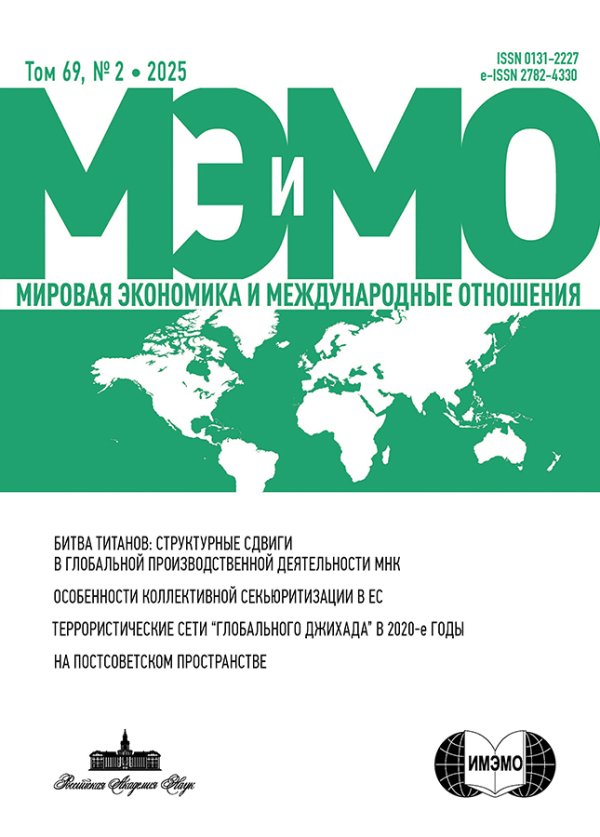
World esonomy and international relations
ISSN (print): 0131-2227, ISSN (online): 2782-4330
Media registration certificate: № 0110246 от 08.02.1993
Founders
- Primakov National Research Institute of World Economy and International Relations, Russian Academy of Sciences;
- Russian Academy of Sciences
Editor-in-Chief
Ryabov Andrei Vilenovich, Cand.of Sc. (History), Associate Professor
Frequency / Access
12 issues per year / Subscription
Included in
White List (2nd level), Higher Attestation Commission List, RISC, Scopus, Web of Science (ESCI)
最新一期
卷 69, 编号 2 (2025)

Economy, Economic Theory
Battle of titans: structural shifts in MNCs global production
摘要
Structural shifts occurring in the global economy are changing the nature and mode of international expansion for multinational corporations (MNCs) and their participation in global production. However, scholars and researchers still have few tools to analyze such shifts, and studies of MNC behavior are often limited by data on foreign direct investment flows, which often do not reflect MNC participation in host countries. We use data from the AAMNE OECD database and demonstrate that using statistics on MNC output allows for a deeper understanding of the structural shifts in MNC participation in global production. The results confirm existing observations that the use of data on FDI flows is insufficient to provide a comprehensive assessment of MNCs' participation in modern global production. The application of MNC output data also provides another perspective on the spread of global value chains and confirms the standard observation that the most active formation of global chains in the last two decades has been in the automotive and computer and electronics industries. The estimates obtained show that the absence of offshoring growth in the case of Chinese MNCs does not necessarily imply limited participation in foreign markets. Moreover, the expansion of offshoring production in developed countries (such as Germany, France, the United States) does not always lead to the spread of global value chains in manufacturing industries. In future research, it would be important to use data on MNC participation in the output of both home and host economies to analyze ongoing structural shifts and assess the effectiveness of industrial policy instruments.
 5-15
5-15


Price mechanisms of digital economy: Divide et impera
摘要
The article analyses digital pricing strategies of the companies in the XXIst century. The detailed investigation of contemporary empirical research papers has shown that digital economy allows companies to use innovative tools in order to control consumers’ behaviour. But these new pricing instruments act as a double-edged sword. A great variety of goods and services with personalised price offers could attract additional demand and result in additional revenues. However, the innovative pricing schemes activate perceived price perceptions of the consumers. Experiments have demonstrated that if price levels, price differentiations or price dynamics are considered unfair, price scenarios have a negative impact on the clients’ loyalty and lead to a decrease in demand. A wide range of prices help companies elaborate obfuscation strategies, with low initial prices and increased additional fees being secretly included into the product bundle. Pricing and revenue optimization is based on widespread usage of AI and sophisticated technological advances that could manipulate consumers’ inattentiveness and carelessness. Although digital technologies and machine-learning could make possible detailed personalized prices on the basis of first-degree price discrimination, the real business models demonstrate prevalence of unitary prices. One reason is that nonlinear pricing with a complex double flat-rate and nonrecurring rate pricing plan still require additional IT expenditures. The other reason lies in competition area. The unitary pricing makes it easier to develop product differentiation that diminishes firms’ rivalry and as a result, escalate market prices. The innovative pricing formats, including price parity clauses, online recommendations systems, per-click fees, referral and registration fees, along with many others, contain anticompetitive potential. That is why they are under thorough monitoring of antitrust authorities all over the world.
16-24
Europe: New Realities
Features of collective securitization in the European Union (The example of the EU Common Security and Defence Policy dynamics)
摘要
The European Union Common Security and Defence Policy (EU CSDP) is currently undergoing the institutional transformation. The CSDP is the crucial component of the EU’s organizational structure, designed for the promotion of European integration in the spheres of security and defence. The EU security and defence is often regarded as an inalienable part of NATO security and defence. However, the current trends, such as the evolving of the Permanent Structured Cooperation (PESCO), implementation of the Strategic Compass, or the plan for achieving strategic autonomy, promote the position of the European Union as one of hard power centers on the international stage. The shift from normative to military power in the EU’s foreign policy signifies a completely new era in the regional security complex. The article explores the dynamic of the CSDP marked by the adoption of “Shared Vision, Common Action: A Stronger Europe” – the global strategy for the European Union’s Foreign And Security Policy, – and of the Strategic Compass for Security and Defence. The author examines the current trends in the EU CSDP, such as the creation and evolution of the Military Planning and Conduct Capability (MPCC) and a possibility of its turn into a fully operated EU military headquarter, the development of the PESCO as a contribution to the European military-industrial complex, and the recent adoption of the Civilian CSDP Compact. The trends are regarded through the methodology of “collective securitization”. The author provides the analysis of its applicability for the examination of the CSDP, highlighting the key steps and factors influencing the process, such as effective security governance and common identity in the sphere of security and defence.
25-33
Immigration and Ethno-Confessional Heterogeneity in Modern France: the Confrontation is Aggravating
摘要
Over the past four decades, French society has changed beyond recognition. The large-scale socio-economic changes that resulted from France’s entry into the global economy were accompanied by the closure of entire industries, the growth of mass unemployment, and shifts in the social structure of society. Another consequence of joining the global economy was a massive increase in immigration. By the time it entered the global world, French society was not monoethnic. However, the policy of assimilation of foreigners pursued by the authorities was focused on the forced cultural rapprochement of new arrivals with the indigenous population, and aimed at turning foreigners into “goodу Frenchmen”. Since the mid‑1980s, the political vector has changed: the policy of assimilation has been replaced by multiculturalism and integration. In 2022, there were 7 million immigrants and 6 million Muslims living in the country. For a long time, issues of ethnocultural and religious diversity in France were kept silent. The principle of a civic nation assumes that the citizens of a country share republican values and are subject to the laws of the Republic. Life has forced us to take a fresh look at the correspondence of normative guidelines to social realities. Over the past decades, France has become a country of ethnic and religious diversity. The ethno-confessional split is increasingly acquiring a political dimension. Is it necessary to accept new immigrants? Is there a chance to integrate French-born children of immigrants and newly arrived foreigners into the host society? These issues are the focus of political debate.
34-43
Greater Middle East
Terrorist networks of the "global jihad" in the 2020s: new forms, locations and challenges
摘要
Despite the heavy damage inflicted on transnational jihadist terrorist networks in the 2010s and 2020s, extremist groups acting under the banner of “global jihad” (primarily the Islamic State and Al-Qaeda) have not only survived, but also demonstrate the ability to adapt to new conditions and still pose a huge threat at different levels in various parts of the world. Terrorist networks have temporarily retreated into the shadows, trying to regroup their forces and find new fields and opportunities for their extremist activities. There are reasons to fear that we may be talking about the “calm before the storm.” A characteristic feature of modern transnational Islamist networks is the expansion of geography, primarily at the expense of African countries. Also, the “Afghan branch” of the Islamic State group (ISKP), which is not limited to the territories of Afghanistan and the countries bordering it, is showing special operational and propaganda activity. The expansion of the geography of terrorist networks is reflected in the evolution of their internal structure (which is especially evident in the example of the development of the management system of the “branches” of the IS network). The article also examines the impact of the war in the Gaza Strip on the activities of transnational jihadist networks. The author concludes that as long as the causes contributing to the growth of religiously motivated extremism and terrorism remain, global jihadist networks will continue to exist using various forms of hybrid warfare (terrorist acts, sabotage and guerrilla activities, seizure of territories for more or less long periods, propaganda war, recruitment activities, undermining public peace, etc.). It is also logical to assume that transnational Islamist terrorist networks will continue to skillfully combine their global ambitions with a purely local agenda, which poses a threat to a number of specific regions. And an equally alarming sign is the ability of adherents of the “global jihad” to use international conflicts for their own purposes.
44-54
ISIL-Taliban: an Existential Confrontation of Regional Significance in Afghanistan
摘要
The article is devoted to the nature and consequences of the existential confrontation of regional significance between ISIS-Khorasan and the Taliban in the new, modern conditions that have developed in recent years against the background of significant differences between the terrorist organization and the Taliban in power. The author emphasizes that the serious rivalry between the two Islamist organizations for the “minds and sentiments” of the people has to a large extent acquired an existential character. The author states the global nature and goal of ISIS-Khorasan to create a transnational caliphate in the historical area of Greater Khorasan, which is completely different from the Taliban's national agenda. It is emphasized that the group pays great attention to discrediting rival jihadist organizations and religious figures who oppose it. It emphasizes the aggressive nature of ISIS-Khorasan, which has plans to overthrow the governments of regional states. ISIS-Khorasan's campaign of recruitment of Afghans and ideological propaganda led to armed conflict with the Taliban. It notes the remarkable resilience of ISIS-Khorasan, despite heavy losses, and strengthening of the group's position after the Taliban came to power in Afghanistan. It is concluded that the ongoing terrorist activity of ISIS-Khorasan leads to the undermining of Kabul's efforts to stabilize the internal situation in the country, complicates the solution of humanitarian and socio-economic problems, discredits the Taliban regime in the eyes of the local population and the international community, and poses a threat to regional states.
55-64
The return of the Taliban to power as a factor in the transformation of threats and challenges to regional security
摘要
The article addresses the issue of the emergence of new challenges and threats to the regional security system in Central and South Asia following the return to power of the Taliban movement in August 2021. Among them is the Taliban’s active policy in constructing the Qoshtepa canal related to the Amu Darya in northern Afghanistan without coordination with the Central Asian countries, posing a threat to the water, environmental, and food security of extensive areas in Turkmenistan and Uzbekistan. The complicating factor is the deterioration of relationship between the Taliban and Pakistan after 2021, rooted in contradictions surrounding the Kabul-non-recognized “Durand Line,” which divides the territory inhabited by many Pashtun tribes and clans on both sides of the Afghan-Pakistani border. An irritant in Afghan-Pakistani relations has been the increased terrorist activities of the Tehrik-e-Taliban Pakistan (TTP) following the establishment of the Islamic Emirate of Afghanistan, resulting in numerous casualties among Pakistani security forces and civilians. Islamabad accuses Kabul of harboring TTP militants on its territory, a claim refuted by the latter. In the long term, a challenge, primarily for a secular Central Asia, may be the Taliban’s anti-modernist policy capable of influencing the growing post-secular trends in countries located north to the Amu Darya.
65-75
China: Domestic and Foreign Policies
Cooperation of China and Central Asia in Renewable Energy
摘要
Central Asian countries (Kazakhstan, Uzbekistan, Turkmenistan, Tajikistan, and Kyrgyzstan) are rich in renewable energy sources such as wind, solar, and hydropower, but the differences in economic development among the five countries have led to uneven development of renewable energy projects. Energy transition, carbon neutrality targets, and geopolitical conflicts make renewable energy development in Central Asian countries full of challenges. Policies to provide tariff reductions, simplify procedures and strengthen international cooperation for renewable energy projects are specified in the legislation on the use of renewable energy. China is the fastest growing country in the field of renewable energy technologies and one of the major investors in the Central Asian renewable energy market. Under the guidance of the One Belt and One Road Initiative, China and Central Asia have launched multi-level and all-round cooperation in the renewable energy sector. China has advanced technology and relatively strong capital, while the advantage of Central Asia lies in its great potential for developing renewable energy (hydro, wind and solar). The two sides carry out renewable energy cooperation, which is complementary to a certain extent, and can achieve mutual benefits and meet the economic development interests of both parties. In recent years, energy cooperation between China and the Central Asian countries within the framework of the One Belt and One Road Initiative has achieved many positive results. Their cooperation had geopolitical, technological and economic advantages, and the One Belt and One Road Initiative provided the Central Asian countries with more opportunities for sustainable development. This study concludes that China and Central Asia are actively promoting renewable energy cooperation under the One Belt and One Road Initiative to expand investment and reduce risks.
76-84
The Taiwan question as a neocolonial problem
摘要
The aggravation of the situation around the unrecognized state in Taiwan is interpreted by Western experts and politicians mainly in a simplified way: the United States is defending the island democracy from mainland authoritarian China. Their forecast boils down to determining the beginning of a supposedly inevitable military clash with one or another set of participants. Despite the fact that Western experts often characterize Chinese policy (in particular, economic policy) as neocolonial, the content of a number of US foreign policy documents gives grounds to conclude that their policy towards Taiwan is neo-colonialist, within the framework of which it serves as a geopolitical satellite and an important source of strategic goods for the neo-metropolis. Washington is seeking to build a stable system of political and economic relations, using not only direct pressure, but also privileges provided to partners that ensure both the military-political dominance of the United States and the uninterrupted supply of strategically important goods. In this context Taiwan can be described as one of the strongholds of US neocolonial policy. This policy has historically been rationalistic and situational in nature, invariably based on a certain understanding of the national interests of the United States, but does not always take into account the expectations of the Taiwanese regime. The results of the 2022 municipal elections, and then the 2024 presidential elections, demonstrated a split in Taiwanese society, which may have resulted in some way from contemplation of the consequences of a potential military conflict with the mainland. This circumstance, as well as the situation in Ukraine, which receives assistance from the United States, can become serious sobering and restraining factors for that part of society and the elite of Taiwan that shares the idea of independence of the island, which gives hope for the prospect of its peaceful reunification with China.
85-96
At the Post-Soviet Space
Educational migration in Eurasia: the case of Kazakhstan
摘要
The article investigates the dynamics of educational migration from Kazakhstan and identifies factors influencing the attraction of foreign students. It traces the evolution of Kazakhstan's educational policy from the 1990s, highlighting significant initiatives like the “Bolashak” program and the country's integration into the European Higher Education Area. The study emphasizes the measures taken to enhance the accessibility and quality of higher education, including the establishment of foreign university branches in Kazakhstan. Using regression analysis, the research identifies key factors influencing educational migration, such as urbanization levels, Internet accessibility, and the number of students enrolled in higher education. The analysis reveals a strong positive correlation between the percentage of Internet users and student outflows, indicating the role of digital information in shaping students' decisions to study abroad. Conversely, urbanization and the number of graduates show a positive impact on attracting foreign students to Kazakhstan. The article also discusses the country’s strategic efforts to become a regional hub for student mobility, particularly through the creation of the Central Asian Higher Education Area (CAHEA). It evaluates recent policies aimed at increasing the proportion of foreign students and the challenges faced in implementing these initiatives. The practical significance of this research lies in its potential to inform policymakers about effective strategies to manage educational migration. By analyzing the relationship between educational policies and migration patterns, the study offers insights into enhancing Kazakhstan's attractiveness as a destination for higher education. The findings highlight the importance of urban educational centers and digital infrastructure in supporting the country's educational goals and reducing brain drain.
97-109
Russia in the South Caucasus Gas Markets
摘要
The article analyzes the features of Russia's interaction with the states of the South Caucasus (Azerbaijan, Armenia, Georgia) in the gas transportation sector. The study of the structure of the markets of the South Caucasian republics allowed us to determine the share of natural gas supplied from Russia, to assess the problems and prospects for further supplies. In recent years, there has been an increase in imports of Russian natural gas to the states of the region, which is caused by both economic and some geopolitical reasons, the identification of which is the purpose of this article. Russian natural gas is exported to the states of the South Caucasus via two gas pipelines – North Caucasus–Transcaucasia (Russia–Georgia–Armenia, Mozdok–Tbilisi–Yerevan) and Baku–Novo-Filya (Russia–Azerbaijan). The study of the characteristics of these gas pipelines allowed us to most comprehensively assess the possibilities of developing gas transportation communications between Russia and the states of the region. In the same context, we should consider the Iran-Armenia gas pipeline, which, although geographically has no outlet on Russia, is nevertheless the property of the Russian state company Gazprom. The high transit potential of the South Caucasus facilitates the development of gas transportation infrastructures here, aimed at forming international energy corridors North–South and East–West, which is today significantly hampered by the unresolved nature of a number of military and political conflicts in the region. At the same time, Russia's interaction with the states of the South Caucasus in the energy and, in particular, gas transportation spheres demonstrates sensitivity to geopolitical processes, which is natural, given the dynamically changing security architecture of the region and attempts of a number of extra-regional actors, including the U.S. and the EU to increase their influence in the region. This dictates the need for Russia and the Soutc Caucasus states to develop a strategy of energy diplomacy aimed at creating sustainable and secure gas transportation communications.
110-119
From the History of IMEMO
Institute of World Economy and World Politics: the 100th anniversary of foundation (Part Two)
摘要
The second part of the history of the Institute of World Economy and World Politics was associated with the name of Valerian Obolenskii, better known under the literary double N. Osinskii. He was an old Bolshevik, a prominent state and party leader, one of the first Soviet Marxist economists. He joined the Institute at the beginning of 1926, and had been workings there for less than two years. Under his leadership, the Institute of World Economy expanded its staff and worked out the main areas of research. At the same time, the Institute began publishing of the “World Economy and World Politics” journal and completed the preparation of the Yearbook under the same name. Both the journal and the Yearbook soon gained international recognition and became the world's first rate periodical analytical editions with economic and political specialization. The successful work of the Institute of World Economy was impeded not only by a small number of researchers, but also by the fact that its director worked there part-time. In 1926–1928, N. Osinskii was simultaneously the head of the Central Statistical Office (CSO), a member of the Soviet government – the Council of People's Commissars of the USSR, which left him little time for full management of the Institute. This article prepared using archival sources examines the activities of the Institute of World Economy and World Politics headed by N. Osinskii (V. Obolenskii) in 1926 – early 1927.
120-130
Around Books
When the Middle Becomes Gold...
131-136