


Vol 9, No 3 (2025)
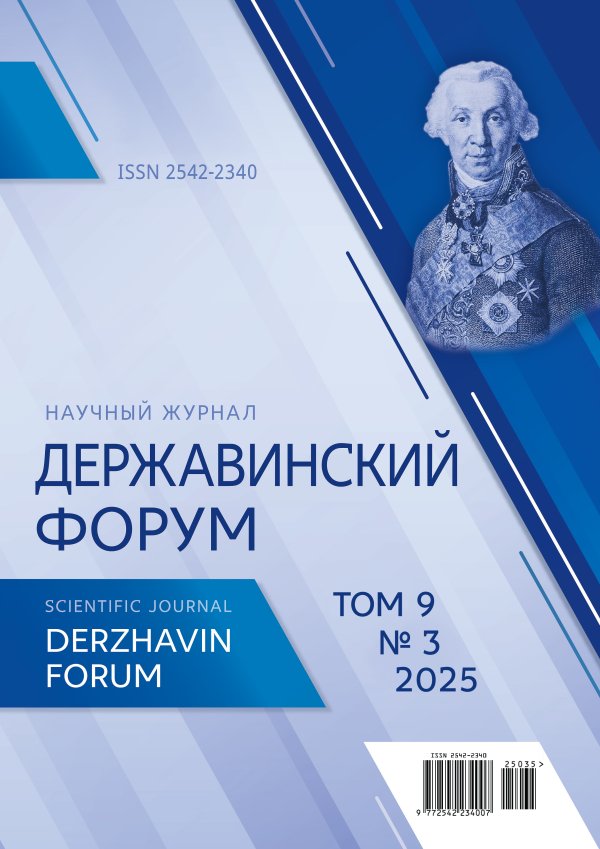
- Year: 2025
- Published: 21.10.2025
- Articles: 15
- URL: https://medbiosci.ru/2542-2340/issue/view/24645
Full Issue

Pedagogy
Modern technologies of teaching foreign languages
Abstract
Modern methods of using technologies for learning foreign languages are considered. Various innovative approaches in teaching, including the use of multimedia resources and artificial intelligence, are analyzed. The functional capabilities of the DeepSeek neural network (conducting a dialogue, generating exercises, explaining words) are considered. The impact of digital technologies on the development of language skills is also analyzed.
 294-300


Features of teaching wood carving in the system of initial artistic education
Abstract
The features of the inclusion of wood carving in the system of primary art education are analyzed. An artistic and pedagogical model of teaching wood carving at the initial stage of art education is proposed. The conclusion is made about the need for a systematic approach that is able to actively and effectively solve problems aimed at the quality of various works performed by students, in addition, quickly and effectively form pre-professional wood carving skills, which generally contributes to the development of a highly motivated art school graduate, as well as the preservation and enhancement of national traditions.
301-307
The potential of conversational communication with DeepSeek to reduce language anxiety: a psychological analysis of cues
Abstract
The problem of language anxiety in learning a foreign language and the role of artificial intelligence in its reduction is considered. The aim of the study is to identify linguistic strategies used by DeepSeek to reduce language anxiety. The use of language support markers, constructions, and expressions is shown on the material of simulated dialogues. The conclusion is made about the potential of DeepSeek as an auxiliary tool in teaching a foreign language.
308-315
Law
Current trends in the investigation of serious and particularly serious crimes
Abstract
This study is devoted to the analysis of current trends in the investigation of serious and particularly serious crimes, the relevance of which is due to increased latency and the use of modern technologies. The importance of improving forensic techniques and analyzing investigative situations is considered, especially in the context of an increase in crime in the field of information and telecommunication technologies. The analysis of current trends is carried out, including the classification of investigative versions, the active use of operational investigative measures, and examples of the use of modern techniques. The purpose of the work is to identify effective investigative methods.
316-320
Historical sciences
A.N. Obolensky’s network connections in the Tambov Province (1907-1908)
Abstract
The aim of the study was to analyze the network connections of the provincial administrator A.N. Obolensky during his service in the Tambov province. The memoirs of A.N. Obolensky and Tambov governor N.P. Muratov served as a source base. A graph of network connections was created and analyzed, on the basis of which it was concluded that A.N. Obolensky had an extensive social circle, which was formed during his service in the Tambov province. It is noted that the largest number of A.N. Obolensky’s connections were with Tambov governor N.P. Muratov and officials of the provincial presence.
321-328
The memory of the Czechoslovak Legionnaires in the culture and art of the modern Czech Republic
Abstract
The memory of Czechoslovak legionnaires in the Czech Republic has been studied. The features of the perception of legionnaires in different periods of the history of Czechoslovakia and the Czech Republic are considered. The Czechoslovak legionnaire community and its role in promoting the legionnaire idea were analyzed. An assessment of the representation of legionnaires in culture and art in the Czech Republic is given.
329-333
Media Communications and Journalism
Genre-thematic diversity of materials in the magazine “Around the World”
Abstract
The analysis of the genre and thematic variety of publications in the magazine “Around the World” is presented. After examining the thematic variety of materials in the magazine, the following topics were identified for the publication: travel, animals, climate, personalities, history, art, science, gastronomy, automobiles, and technology. In terms of genre variety in the magazine, the most prevalent genres in the publication include reportage (15 %), investigative journalism (14 %), articles
(14 %), notes (11 %), and interviews (8 %).
334-341
Mediapolis as the basis of the city’s brand
Abstract
The role of urban identity and the media dimension of the city (media city) in the formation of its brand are investigated. The interpretations of the concept of “city brand”, the mechanisms of interaction between media and urban space, the role of urban identity as a resource for building a brand are considered. Special attention is paid to the influence of digital technologies and social networks on the perception of the urban environment by residents and visitors of the city.
342-346
The role of publishing houses in the mass communications system (on the example of the Rostov region)
Abstract
The main characteristics of the large publishing houses of the Rostov region are considered. The analyzed data led to the conclusion that Rostov publishers are working in different directions. Some publishing houses actively interact with readers, while others practically do not engage in external communication.
347-354
Immersive and neural networks technologies in fashion journalism
Abstract
Immersive and neural network technologies are actively used in fashion publications, the content of which is aimed at shaping the values and norms of audience behavior. The novelty of the research lies in the analysis of the use of these technologies in fashion journalism, which makes it possible to identify new formats for presenting content and forms of interaction with the audience. The empirical research material includes articles by The Blueprint, Vogue, publications about the “Vogue × Snapchat” fashion exhibition, and advertisements for the Balmain autumn collection.
355-361
The magazine “Azovo-Dono-Kuban Vodnik” in the information space of the Don region of the twentieth century
Abstract
The study of the history of the regional press is a relevant field that covers many important aspects. Regional magazines such as “Azovo-Dono-Kuban Vodnik” act as carriers of cultural heritage, broadcasting the unique features of the region, its traditions, and customs. The typological analysis of the magazine “Azovo-Dono-Kubansky Vodnik” is given on the basis of the archival issues of the publication for 1923. The study uses the methodology proposed by A.I. Akopov.
362-368
Философия и культурология
Intellectual synergy of humans and artificial intelligence: avoid or integrate?
Abstract
The phenomenon of the relationship between humans and artificial intelligence, the possibility of integrating a neural network into society as a separate cell is studied. The philosophical and mathematical ideas that served as the basis for the development of the concept of artificial intelligence in their historical development are considered. The influence of artificial intelligence on humans is highlighted, and the prerequisites for merging with neural networks are identified. The conclusion is made about the ambiguity of the position of artificial intelligence in society based on the assessment of its safety for humans.
369-373
Features of the festival’s corporate identity as an event environment
Abstract
The theoretical foundations of the festival’s corporate identity concept, including its concept, elements, and media, are presented. Various types of festivals are described, as well as the requirements and principles of creating a corporate identity. The analysis of examples of world festivals and their individual components is carried out. The conclusion is made about the need to apply an integrated approach to the organization of the festival as an event environment and the creation of its corporate identity.
374-380
Geosciences and environmental sciences
The content of microplastic particles in the waters of the Tsna River upstream and downstream from the confluence of the Lesnoy Tambov River
Abstract
The content of microplastic particles in the Tsne River upstream and downstream from the confluence of the Lesnoy Tambov River near the village of Kuzminogat in the Tambov region is considered. The applied method of sample preparation for the study is described, as well as the methods used for particle detection. Based on the results of the study, quantitative and qualitative characteristics of the detected microplastic particles are given. A total of 101 microplastic particles were detected. The size is 0.1–5 mm. The main type is fibers. The color is varied.
381-389
Рецензия
The literary twentieth сentury in the latest research: about one landmark monograph
Abstract
The book of articles by A.I. Vanyukov “Literary twentieth Century-2: Magazines, books, genres” (Saratov, 2025) is being reviewed. The connection with the previous monographic editions of the author is traced, and their unified structural and thematic integrity is established.
390-394